That official-looking “Apostille” stamp on your degree certificate? For any official use in Dubai, it might as well be invisible.
It’s a frustrating reality for countless expats who arrive in the UAE, confident their documents are ready, only to face rejection at a government counter. The confusion surrounding the apostille vs attestation uae process is a major roadblock, costing time, money, and causing unnecessary stress. You’ve done the hard work of securing a job or setting up a business; your paperwork shouldn’t be the final, unexpected hurdle.
This definitive 2026 guide is designed to eliminate that uncertainty. We will provide you with a clear, actionable roadmap to successfully legalize your documents for use across the UAE, ensuring they are accepted the first time. We’ll break down precisely why an Apostille isn’t recognized, detail the multi-step attestation chain required by the UAE Ministry of Foreign Affairs (MoFA), and show you how to navigate the entire process seamlessly.
Key Takeaways
- Determine whether your document needs a simple Apostille or the full, multi-step Attestation process required for official use within the UAE.
- Understand the complete legalization journey, from notarization in your home country to final verification by the UAE’s Ministry of Foreign Affairs.
- Learn the critical differences in the apostille vs attestation uae comparison, particularly regarding processing time and total costs.
- Identify which of your personal or educational documents, such as degrees and marriage certificates, require attestation for Dubai visas and employment contracts.
Understanding Apostille vs Attestation in the UAE Context
When preparing official documents for use in the United Arab Emirates, you will inevitably encounter two terms: apostille and attestation. While they sound similar, they represent two distinct legal processes, and understanding the difference is critical to avoid costly delays and rejections. The core of the issue in the apostille vs attestation UAE debate lies in a single, crucial fact: the UAE is not a signatory to the Hague Apostille Convention.
This means that while many countries have a simplified, one-step process for authenticating documents for international use, the UAE requires a more comprehensive, multi-step chain of verification. Whether you’re submitting an educational degree for a job, a marriage certificate for a residency visa, or corporate documents to set up a business in Dubai, you must follow the UAE’s specific attestation protocol. An apostille alone is never sufficient.
What is an Apostille?
An Apostille is a certificate that authenticates the origin of a public document. It was established by the Apostille Convention, a treaty drafted during the Hague Conference on Private International Law on October 5, 1961. Its purpose is to streamline the legalization process between member countries by replacing the often lengthy, chain-based attestation with a single, standardized certificate. Today, more than 120 countries, including the UK, USA, India, and Australia, issue Apostilles to certify documents for use in other member nations.
What is UAE Document Attestation?
UAE Document Attestation is the mandatory, multi-step process required to verify the authenticity of any foreign document intended for official use within the Emirates. This chain of legalization confirms that the seals and signatures on the document are genuine. The final and most critical step is the stamp of approval from the UAE’s Ministry of Foreign Affairs (MOFA). In all local courts, government departments, and free zones, “Attestation” is the legally recognized and required standard for document validity.
The most common point of failure for individuals and businesses is misunderstanding the role of an apostille in this process. If your document originates from a Hague Convention country like the United States, obtaining an apostille (e.g., from the U.S. Department of State) is not the final step. Instead, it is only the first step of home-country legalization. It certifies the document’s authenticity within its country of origin, making it ready for the next stage: verification by the UAE Embassy in that country.
For example, a university degree from the UK must first be apostilled by the UK’s Foreign, Commonwealth & Development Office (FCDO). Only after that is it ready to be presented to the UAE Embassy in London for their stamp. The final step is getting it stamped by MOFA upon its arrival in the UAE. Without this complete chain, the document holds no legal weight here.
In short, the key distinction in the apostille vs attestation UAE framework is that an apostille is a component of the attestation process for many countries, but it is never the conclusion. Getting this right is fundamental to ensuring your personal and professional transitions in the UAE are seamless and successful. Our experts can facilitate this entire end-to-end process, ensuring your documents meet all legal requirements from the comfort of your home or office.
The Multi-Step Journey of UAE Document Legalization
Understanding the difference in the apostille vs attestation UAE debate starts with recognizing that attestation isn’t a single action; it’s a sequential, multi-stage validation process. Unlike the one-step Apostille, getting a document legally recognized for use in the United Arab Emirates involves a chain of verifications that crosses international borders. Each stamp and signature acts as a link in a chain of authenticity, ensuring your document is fully compliant with UAE government standards before it can be used for a visa, business setup, or legal proceeding.
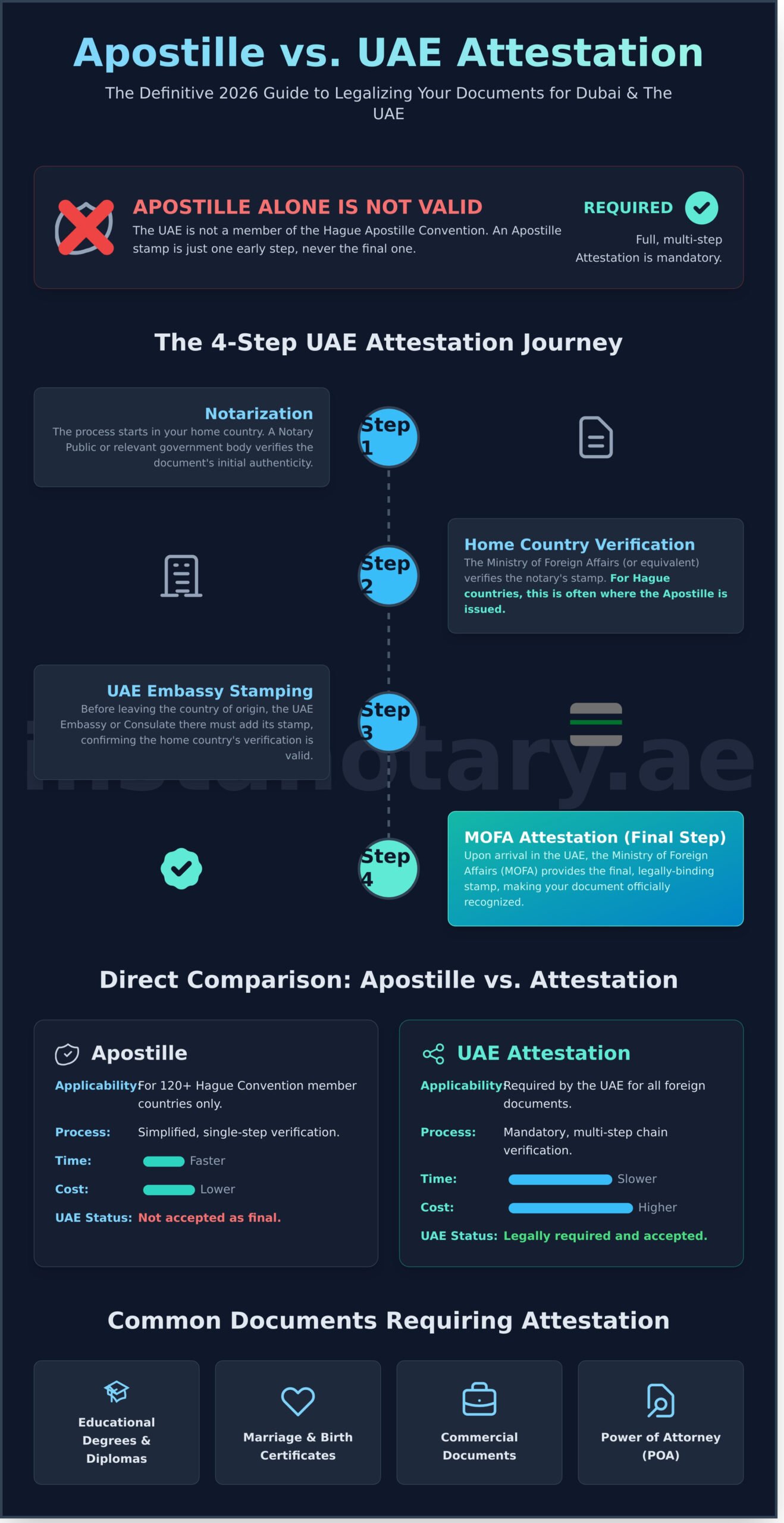
This rigorous journey guarantees that by the time your document reaches a UAE authority, its legitimacy is beyond question. The process typically follows four critical steps:
- Step 1: Notarization in the Country of Origin. The process begins locally. A recognized authority, such as a Notary Public or a relevant government department (e.g., the Department of Health for a medical certificate), must first verify the document in its home country. This initial step confirms the authenticity of the signatures on the document itself.
- Step 2: Verification by the Home Country’s Ministry of Foreign Affairs. Next, the Ministry of Foreign Affairs (or an equivalent body like the State Department in the US) in the document’s country of origin must verify the authority of the official from Step 1. This stamp elevates the document’s validity from a local to a national level.
- Step 3: UAE Embassy or Consulate Stamping. Before the document leaves its home country, it must be presented to the UAE Embassy or Consulate. Officials here will verify the stamp from the home country’s Foreign Ministry, effectively giving the document a green light for entry into the UAE’s legal system.
- Step 4: Final MOFA Attestation within the UAE. The final step occurs upon the document’s arrival in the Emirates. You must submit it to the UAE Ministry of Foreign Affairs (MOFA) for the final attestation stamp. Only after this seal is applied is the document considered legally valid for official use across the UAE.
This intricate sequence can be complex and time-consuming. Managing correspondence and requirements across multiple government bodies in different countries requires meticulous attention to detail. Our experts are equipped to facilitate this entire attestation journey, ensuring every step is completed correctly and efficiently.
The Role of the UAE Embassy Abroad
The stamp from a UAE Embassy in your home country is the critical link between your document’s origin and its destination. It serves as the official confirmation that the previous verifications are legitimate according to UAE standards. Without this embassy stamp, MOFA in Dubai or Abu Dhabi will reject the document outright. This stage often presents challenges, including unpredictable processing backlogs and highly specific submission requirements that can vary from one embassy to another.
MOFA Attestation: The Final Seal of Validity
The current hybrid process for the final attestation combines digital efficiency with physical verification. Applicants typically initiate the service through the official MOFA website, but the final step involves presenting the physical document at a MOFA service center in locations like Dubai or Abu Dhabi for the official sticker or stamp. You can find detailed guidance on the official UAE attestation process directly on the ministry’s portal. In essence, MOFA attestation is the ultimate verification that renders a foreign document legally valid and officially recognized for use within the United Arab Emirates.
Direct Comparison: Apostille vs Attestation
Understanding the core differences between an apostille and attestation is crucial for anyone bringing foreign documents into the UAE. While both processes validate a document’s authenticity, their application, complexity, and cost are worlds apart. The debate of apostille vs attestation UAE has a clear winner for documents destined for use here.
Here’s a direct breakdown of the key distinctions:
- Speed: An apostille is a fast, single-step process, often completed in one business day. Attestation is a multi-stage journey that can take several weeks or even months to complete.
- Complexity: An apostille requires just one official stamp from a designated authority in a Hague Convention member country. Attestation demands a chain of verifications, typically involving 4-5 different stamps from government departments in both the origin country and the UAE.
- Cost: An apostille usually has a single, fixed government fee. Attestation costs accumulate with each stamp and verification, making it significantly more expensive.
- Geographic Reach: An apostille is only valid between the 120+ member countries of the Hague Apostille Convention. Attestation is the required standard for legalizing documents for use in countries that are not members, including the United Arab Emirates.
The fundamental reason for this difference is the UAE’s status as a non-signatory to the Hague Convention. This means it doesn’t recognize the simplified apostille process. Instead, it requires a more rigorous, multi-layered verification to ensure the complete legitimacy of foreign documents. This chain of verification is standard for non-member countries; for example, the U.S. Department of State authentication process clearly distinguishes between a simple apostille for member countries and a full authentication certificate required for nations like the UAE.
When is an Apostille Sufficient?
For official use within the UAE, an apostille is almost never sufficient. Any document required for a visa application, business setup, employment contract, or legal proceeding in Dubai or Abu Dhabi must undergo full attestation. While a document might be apostilled in its country of origin (e.g., the UK), it will still need to be presented to the UAE Embassy in that country and then to the UAE Ministry of Foreign Affairs (MOFA) upon arrival here. Don’t make the costly mistake of assuming an apostilled document is ready for use in the UAE.
The Cost Factor in the UAE
The financial difference in the apostille vs attestation UAE comparison is significant. While an apostille might cost the equivalent of a few hundred dirhams, attestation fees are layered and variable. In the UAE, the final step at the Ministry of Foreign Affairs (MOFA) alone carries a specific fee that depends on the document type:
- Personal Documents: A university degree or birth certificate typically costs د.إ 150 for MOFA attestation.
- Commercial Documents: A commercial invoice, Power of Attorney, or Memorandum of Association costs approximately د.إ 2,000 per stamp.
These figures don’t include the fees charged by the notary, state department, and UAE Embassy in the document’s home country. Courier fees, translation services, and administrative charges can also add to the final bill. Navigating this without expert guidance often leads to unexpected expenses and delays. Using a professional facilitator ensures cost transparency and prevents costly errors, streamlining the entire process from start to finish.
Common Documents Requiring Attestation in Dubai
While the apostille vs attestation UAE distinction is critical, the reality for most individuals and businesses dealing with the Emirates is that full attestation is the required standard. Because the UAE is not a signatory to the Hague Apostille Convention, documents from the vast majority of countries must undergo a multi-step verification process to be legally recognized. This process is essential for three primary categories of documents: personal, educational, and corporate.
Personal documents are fundamental for managing life events in the UAE. You’ll need to attest these for various official purposes:
- Marriage Certificates: Essential for sponsoring a spouse’s residence visa, co-signing rental agreements, or for certain legal proceedings.
- Birth Certificates: Required to sponsor a child’s visa, for school enrollment, and to obtain an Emirates ID for your dependents.
- Death Certificates: Necessary for estate management, processing inheritance claims, and cancelling a deceased person’s visa.
Attesting Educational Degrees
To secure a professional visa designation that matches your qualifications, your educational certificates must be fully attested. This is a non-negotiable requirement for many skilled roles. The process for a full bachelor’s or master’s degree is often more rigorous than for a diploma, typically requiring direct verification from the issuing university’s registrar. Your academic transcripts and mark sheets must be attested alongside the main certificate, as authorities like the Ministry of Education (MOE) request them as a complete set for equivalency purposes.
Corporate and Business Attestation
For companies, document attestation is a core part of establishing and maintaining legal operations in the UAE. The process ensures that foreign corporate documents have legal standing within the country’s jurisdiction. Key examples include notarizing a Board Resolution to authorize the setup of a UAE branch office or attesting a Power of Attorney (POA) issued abroad to grant legal authority to a local representative. For international trade, attesting Commercial Invoices and Certificates of Origin is vital for seamless customs clearance and banking transactions.
The complexities of corporate attestation can delay critical business operations. Let InstaNotary facilitate the entire process for you. Contact our experts for a streamlined solution.
The final, often overlooked, step for many documents is legal translation. After your document has been fully attested and bears the final stamp from the UAE Ministry of Foreign Affairs (MOFA), it must be translated into Arabic if you intend to use it in UAE courts or most government departments. This translation must be performed by a sworn translator officially licensed by the UAE Ministry of Justice to ensure it’s legally binding. This final stage is just as important as the initial verification when navigating the apostille vs attestation UAE framework.
How InstaNotary Facilitates Your Legalization Needs
Understanding the technical differences in the apostille vs attestation UAE debate is one thing; successfully navigating the multi-step legalization process is another. The path is often filled with procedural complexities, strict formatting requirements, and time-consuming visits to various government offices. This is where a professional facilitator becomes your most valuable asset, transforming a stressful obligation into a seamless, managed process.
Insta Notary Services acts as your dedicated agent, bridging the gap between you and the necessary authorities. We provide a one-stop solution that handles every critical stage of document legalization from the comfort of your home or office. Our service is built on four pillars of efficiency:
- Expert Document Preparation: Our legal specialists meticulously review, draft, and prepare your documents to meet the exact standards of UAE authorities. This focus on precision minimizes the risk of rejections, saving you invaluable time and additional fees.
- Full-Spectrum Coordination: We manage the entire chain of legalization. This includes coordinating with certified translators, private notary publics for notarization, and submitting documents to government bodies like the Ministry of Foreign Affairs (MOFA) for the final attestation stamp.
- Digital-First Convenience: We leverage a secure, digital platform designed for modern expats and global businesses. You can initiate your request, upload documents, and track progress entirely online, eliminating the need for physical appointments and paperwork.
- Stress and Error Reduction: Forget long queues and the anxiety of potential mistakes. Our team handles the legwork and bureaucracy, ensuring your documents are processed correctly and efficiently, allowing you to focus on what truly matters.
Why a Facilitator is Essential in 2026
As the UAE government continues its ambitious digital transformation, with major updates to MOFA’s e-services anticipated by 2026, the procedural landscape is constantly evolving. A professional facilitator ensures you remain compliant with the latest Ministry of Justice regulations and digital submission protocols. Our experts provide critical advice on the variable requirements for different documents, from educational certificates to commercial invoices, ensuring your application is always current and correct.
Start Your Hassle-Free Process Today
Take the complexity out of document legalization. Our process begins with a simple online submission, where your documents receive an initial review from our expert team. We provide you with a transparent timeline and a clear breakdown of the steps involved, so you are always informed. Don’t let procedural hurdles delay your personal or business objectives. Contact Insta Notary Services for expert assistance with your UAE attestation and let our team manage the entire process for you.
Navigate Your UAE Document Legalization with Confidence
Understanding the critical difference in the apostille vs attestation UAE debate is your first step toward a smooth transition in Dubai. The key takeaway is simple: as a non-signatory to the Hague Convention, the UAE requires the comprehensive, multi-step attestation process for all foreign documents. This journey, involving verification in your home country and final legalization by the UAE’s Ministry of Foreign Affairs (MOFA), leaves no room for error and can be a significant administrative burden.
You don’t have to manage this intricate process alone. At InstaNotary, we provide a seamless, digital-first solution built for Dubai expats. Our specialists have mastered the exact procedures of the UAE’s Ministry of Justice and MOFA, ensuring your documents are processed efficiently and correctly the first time. Whether it’s a Power of Attorney for a property transaction or critical corporate notarizations for your business setup, our expertise is your advantage.
Remove the uncertainty and delays from your document legalization. Let our team provide the fast, secure, and legally sound facilitation you need to move forward. Your seamless transition to life and business in the UAE is just a click away. Get Expert Assistance with Your UAE Attestation Today.
Frequently Asked Questions
Is an Apostille the same as an Attestation in the UAE?
No, an Apostille is not the same as an Attestation and is not a substitute for it in the UAE. Because the UAE is not a signatory to the Hague Apostille Convention, it doesn’t recognize the Apostille certificate. Any document with an Apostille still requires full, multi-step attestation, including legalization by the UAE Embassy in the origin country and a final stamp from the UAE Ministry of Foreign Affairs (MOFA) to be legally valid here.
Does the UAE accept Apostilled documents from the UK or USA?
No, the UAE does not accept documents from the UK or USA with only an Apostille. While both countries issue Apostilles, these documents are considered incomplete for use in the Emirates. They must undergo the full attestation process. This means after getting an Apostille, the document must still be legalized by the UAE Embassy in Washington D.C. or London, and then finally attested by MOFA inside the UAE to be officially recognized.
How long does it take to get a document attested in Dubai?
The complete attestation process typically takes between 3 and 15 business days. The timeline varies significantly based on the document’s country of origin and the efficiency of its government bodies. The final MOFA attestation step in Dubai is fast, often completed in 1-2 days. However, the preceding steps abroad, such as verification and UAE Embassy legalization, account for the majority of the time. We can help manage this process for optimal speed.
Can I attest my documents online in the UAE?
You can start the process and pay the fees online, but the final attestation requires a physical stamp. The UAE Ministry of Foreign Affairs (MOFA) provides a digital portal to submit your application and make payments. However, the original document must still be physically submitted to a MOFA service center to receive the official attestation sticker. Our service handles this entire logistical process for you, ensuring a seamless, hassle-free completion from your home or office.
What happens if I try to use an Apostilled document without UAE attestation?
An Apostilled document without full UAE attestation will be rejected by all official entities in the UAE. Government departments, banks, employers, and free zones will not accept it for any formal procedure, such as a residence visa application, employment contract, or business setup. This will lead to significant delays and the certain failure of your application. The distinction in the ‘apostille vs attestation uae’ framework is critical for legal compliance.
Do I need to translate my document before attesting it in the UAE?
Yes, if your document is in any language other than Arabic, it must be legally translated into Arabic. This translation must be done by a sworn translator certified by the UAE Ministry of Justice after the full attestation process is complete. The certified Arabic translation is then presented alongside the original attested document for official use, especially in court proceedings, visa applications, and other governmental transactions. We can facilitate this crucial step for you.
What are the MOFA attestation fees in Dubai for 2026?
As of early 2024, the standard fee set by the Ministry of Foreign Affairs (MOFA) for attesting a personal document is AED 150. For commercial documents, the fee is AED 2,000. While fees for 2026 have not been officially announced, these figures serve as a reliable guide. These government fees don’t include service charges, courier fees, or costs for prior legalization steps. Contact us for a clear, all-inclusive quote covering the entire process.
Can a private notary in Dubai provide an Apostille?
No, a private notary in Dubai cannot issue an Apostille. The Apostille certificate is exclusively issued by designated authorities in countries that are members of the Hague Convention. Since the UAE is not a member, no entity within the country, whether public or private, has the authority to issue them. A private notary can, however, notarize a document, which is often the first step in the attestation process for documents originating within the UAE.
Disclaimer
This article is for general informational purposes only and does not constitute legal or professional advice. Procedures, requirements, and fees may vary depending on the relevant authority and the specific case. Please contact us directly for guidance based on your situation.