
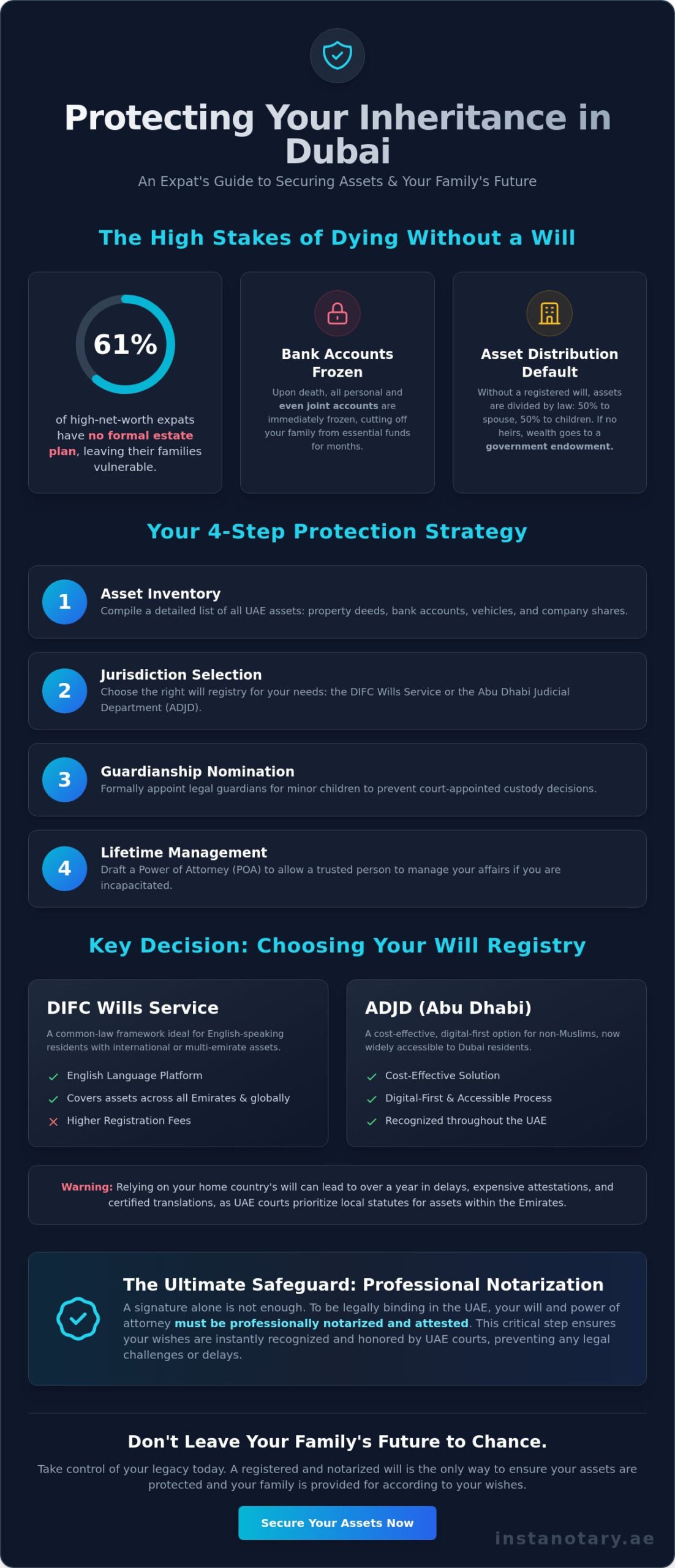
Your bank account is frozen. It’s a chilling thought, but for many families in the UAE, it’s the immediate reality following the loss of a loved one. You’ve worked hard to build a life here, yet learning how to protect my inheritance as an expat in Dubai often feels like trying to solve a puzzle with missing pieces. You aren’t alone in your concern; a 2024 study revealed that 61% of high-net-worth expats have no formal estate plan in place.
We know the fear of Sharia law overriding your wishes or your assets being transferred to a charitable endowment under the latest 2026 regulations is stressful. You deserve the peace of mind that comes with a bulletproof legal strategy. This guide provides the clarity you need to secure your Dubai assets and ensure your family’s future stays protected under current UAE law. We’ll walk you through the critical differences between DIFC and ADJD wills and show you how professional notarization acts as the ultimate safeguard for your legacy.
Key Takeaways
- Learn why Dubai bank accounts are frozen immediately upon death and how to ensure your family maintains instant access to liquid funds.
- Understand the 2026 legal updates regarding how to protect my inheritance as an expat in Dubai to prevent assets from being transferred to government-supervised endowments.
- Compare the registration processes of the DIFC Wills Service and the Abu Dhabi Judicial Department to choose the most secure jurisdiction for your property and business interests.
- Discover how professional notarization and attestation provide the legal validity needed to ensure your home country’s wishes are honored in the UAE.
- Identify the specific steps to nominate legal guardians for minor children to avoid court-appointed custody decisions.
Understanding the Inheritance Risks for Dubai Expats
The legal landscape shifted significantly on January 1, 2026, with Federal Decree-Law No. 51 of 2024 taking full effect. If you haven’t yet researched how to protect my inheritance as an expat in Dubai, you’re likely relying on the “Sharia Default” by accident. While the UAE has modernized its civil laws to offer non-Muslims a secular distribution model, the process remains rigid. Without a registered will, your assets are distributed according to fixed percentages: 50% to your spouse and 50% divided equally among your children. If no heirs are found, your hard-earned wealth is transferred to a government-supervised charitable endowment rather than your preferred causes.
Immediate liquidity is your family’s biggest hurdle. Once a death certificate is issued, Dubai banks are legally required to freeze all accounts held by the deceased. This includes joint accounts. This often leaves the surviving spouse without access to grocery money or school fees for months while the court processes the estate. This high-stakes environment is shaped by the complex Legal System in the UAE, which balances traditional principles with modern civil codes. Your most vulnerable assets include your primary residence, local bank balances, and your end-of-service gratuity benefits.
Why Your Home Country’s Will Might Not Be Enough
Many residents believe their “Global Will” from the UK, Europe, or India covers their local interests. It doesn’t. Local courts often view these documents as secondary evidence rather than binding instructions. Relying on a foreign will triggers a cycle of expensive embassy attestations and certified translations that can delay asset distribution for over a year. The conflict of laws principle in the UAE dictates that local courts generally prioritize national statutes over foreign probate orders when dealing with fixed assets located within the Emirates. To avoid these administrative traps, you need a document that is recognized instantly by the UAE Ministry of Justice.
Steps to Protect Your Inheritance as a Dubai Expat
Securing your legacy requires a proactive strategy rather than a reactive one. Understanding how to protect my inheritance as an expat in Dubai involves more than just a signature; it requires choosing the right legal platform for your specific assets. You can manage most of these steps through our digital platform from the comfort of your home or office, ensuring your estate is air-tight before administrative hurdles arise.
- Step 1: Asset Inventory. Create a detailed list of your UAE-based assets. This includes property title deeds, local bank accounts, vehicle registrations, and company shares.
- Step 2: Jurisdiction Selection. Decide between the DIFC Wills Service Centre or the Abu Dhabi Judicial Department (ADJD) based on your language preference and asset locations.
- Step 3: Guardianship Nomination. Formally appoint legal guardians for minor children to ensure they remain with your chosen family members rather than entering state-regulated care.
- Step 4: Lifetime Management. Draft a Power of Attorney UAE to allow a trusted representative to manage your affairs if you’re ever incapacitated.
DIFC vs. ADJD: Choosing Your Will Registry
The DIFC Wills Service provides a common-law framework that is ideal for English-speaking residents with international or multi-emirate assets. It offers a high degree of certainty but comes with higher registration fees. Alternatively, the ADJD is a cost-effective, digital-first option for non-Muslims that is now widely accessible to Dubai residents. Check our guide on Essential Legal Documents for Expats in Dubai to compare the specific requirements for each registry.
Foundations and Trusts for High-Value Assets
For investors with significant property portfolios, a Dubai foundation provides a corporate layer of protection. This legal entity owns the assets, meaning they don’t form part of your personal estate upon death. By using this structure, you avoid the probate process entirely. It’s an elite wealth management tool that ensures a seamless, instant transition of assets to your heirs. If you’re ready to secure your assets, you can view our full list of document facilitation services to begin the process today.
Ensuring Validity Through Notarization and Attestation
A signature alone doesn’t create a binding legal document in the UAE. To master how to protect my inheritance as an expat in Dubai, your paperwork must be notarized by a recognized authority. This critical step transforms your private wishes into a legally enforceable mandate that Dubai courts and banks are required to honor. Using a Private Notary allows you to fast-track this protection, skipping the long queues at government centers while maintaining total legal integrity from your home or office.
Documents issued outside the UAE, such as marriage certificates or foreign property deeds, require MOFA attestation to be recognized locally. It’s the final seal of approval for any cross-border estate plan. Don’t let simple errors stall your progress. Common mistakes like using uncertified translations or presenting an expired Emirates ID cause significant delays during the notarization process and can leave your assets vulnerable during a transition.
The Digital Advantage: Online Notary Services in 2026
Modern legal services have evolved to match your pace. You can now use secure digital platforms to notarize your inheritance documents in minutes. These services utilize blockchain-verified notarization, providing an immutable record of your document’s authenticity that is virtually impossible to tamper with. This technology ensures full compliance with 2026 UAE Ministry of Justice standards while offering elite convenience. You can access our notary services in Dubai for immediate document authentication and digital peace of mind.
What to Do Next: A Professional Action Plan
Your immediate action plan should focus on preparation. Gather high-resolution copies of your passport, property title deeds, and the contact details of your chosen witnesses. Precision is vital because even a minor drafting error can invalidate your entire estate plan under current civil codes. We recommend you contact a legal facilitator before you begin drafting to ensure your paperwork aligns perfectly with how to protect my inheritance as an expat in Dubai according to the latest 2026 regulations.
Secure Your Dubai Legacy for 2026 and Beyond
Leaving your family’s future to chance isn’t an option when the legal tools for protection are more accessible than ever. You’ve learned that immediate asset freezing is a standard procedure following a death; however, a registered will provides the necessary key to unlocking those funds. By choosing the right jurisdiction and ensuring every document meets UAE Ministry of Justice standards through professional notarization, you remove the administrative burden from your loved ones. Understanding how to protect my inheritance as an expat in Dubai is ultimately about taking action before the need arises.
Our specialists focus on expat inheritance and POA drafting, ensuring your documents are legally sound and ready for immediate use. We provide seamless remote notarization that respects your schedule and adheres to the highest security protocols. Don’t let a missing attestation or a drafting error compromise your hard-earned assets. Secure your legacy today with fast, professional notary services in Dubai.
Taking this step today ensures that your wishes are respected and your family is cared for exactly as you intended. You’ve built a remarkable life in the UAE; now it’s time to protect it with absolute confidence.
Frequently Asked Questions
Is my foreign will valid in Dubai for property inheritance?
Foreign wills are not automatically enforceable for UAE real estate. You would need a complex chain of embassy attestations and certified translations to even present a foreign will in court. Even with these steps, local courts often prioritize UAE civil codes over foreign probate orders. Registering a local will remains the only foolproof method for how to protect my inheritance as an expat in Dubai.
What happens to my Dubai bank account if I die without a will?
Your Dubai bank account is frozen the moment the bank receives notification of death. This legal block applies to both personal and joint accounts. Access is only restored once the court issues a succession certificate, a process that can take six months or longer without a registered will. This freeze can cause immediate financial hardship for families relying on local liquidity.
How much does it cost to register a DIFC will in 2026?
As of April 2026, registering a single will at the DIFC Wills Service costs AED 10,000. Mirror wills for spouses are priced at AED 15,000. For residents focusing solely on real estate, a Property Will is available for AED 7,500. These are official government fees, and additional costs for professional drafting and translation services may apply depending on your specific requirements.
Can I protect my inheritance without a lawyer in the UAE?
You can secure your assets without a lawyer by working with a private notary or legal facilitator. These services focus on the practical documentation needed for inheritance, such as drafting and notarizing a Power of Attorney or preparing will registrations. Using a digital platform ensures your paperwork complies with current 2026 regulations while avoiding the high hourly rates associated with traditional law firms.
Disclaimer
This article is for general informational purposes only and does not constitute legal or professional advice. Procedures, requirements, and fees may vary depending on the relevant authority and the specific case. Please contact us directly for guidance based on your situation.