
What if your family discovered that your UAE bank accounts were frozen and your children’s guardianship was left in limbo simply because you chose the wrong legal framework? You’ve likely realized that inheritance laws for non-Muslims in the Emirates can feel unpredictable, and the fear of administrative delays is a heavy burden for any expat living in Dubai. Understanding the differences between difc wills vs ad wills is one of the most critical financial decisions you’ll make in 2026.
This guide provides a professional, side-by-side comparison of both jurisdictions to help you protect your assets and secure your family’s future with absolute certainty. We’ll break down the specific registration costs in AED, legal validity, and the ease of the application process for each option. You’ll gain a clear, structured roadmap to ensure your estate planning is seamless and your legacy is protected from the comfort of your home or office.
Key Takeaways
- Understand why a registered will is essential in 2026 to prevent the immediate freezing of UAE bank accounts and bypass default Sharia-influenced inheritance laws.
- Discover the benefits of the DIFC Will, a Common Law solution conducted entirely in English that offers specific protections for property, financial assets, and guardianship.
- Explore the Abu Dhabi (ADJD) Will as a versatile, bilingual option that provides comprehensive legal coverage for your assets across all seven Emirates, including Dubai.
- Compare registration fees in AED and language requirements in our side-by-side difc wills vs ad wills analysis to determine which jurisdiction fits your family’s needs.
- Learn how to facilitate a seamless registration process by utilizing expert document preparation and drafting services from the comfort of your home or office.
Why Every Expat in Dubai Needs a Registered Will in 2026
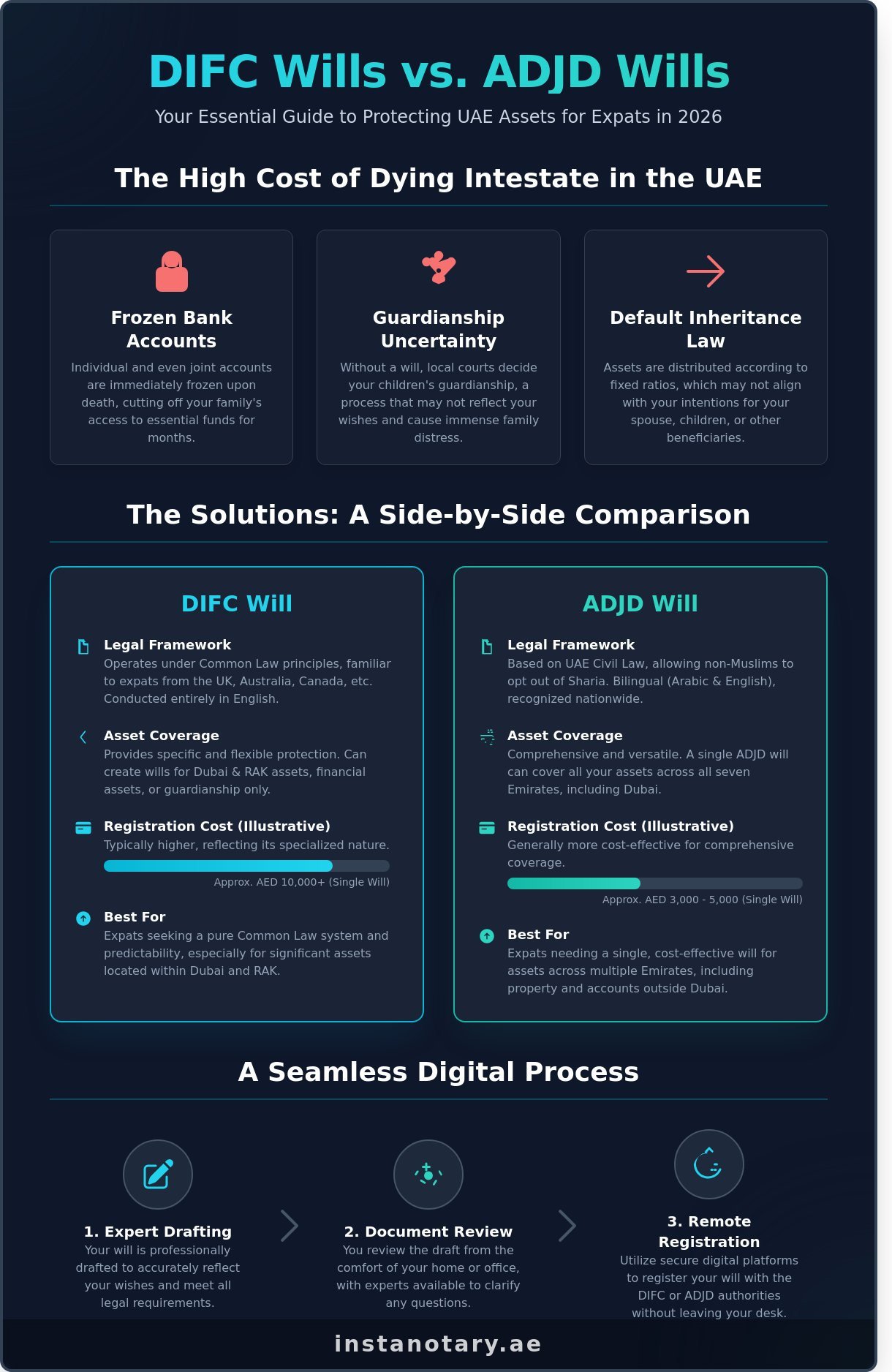
Living in Dubai as an expat in 2026 offers a world-class lifestyle, but it demands proactive legal planning to protect your family and assets. If you pass away without a registered will, you’re considered intestate. In these cases, the UAE authorities apply default inheritance principles often influenced by Sharia law. These regulations distribute assets according to fixed ratios that may not align with your personal wishes. Understanding the differences between difc wills vs ad wills is the first step toward securing your legacy and ensuring your assets reach your intended beneficiaries without unnecessary legal hurdles.
A registered will is your primary defense against the immediate freezing of local bank accounts. When a resident passes away, the UAE banks typically freeze all individual accounts, and often joint accounts, until the court issues a succession certificate. This process can take several months. Without access to funds, surviving family members often struggle to cover daily expenses, school fees, or even funeral costs. By registering a will, you provide a clear, legally binding roadmap that facilitates the swift release of assets and maintains your family’s financial stability.
Guardianship of minor children is perhaps the most critical reason to act now. In the absence of a registered will, the UAE courts follow local procedures to determine who will care for your children. This can lead to temporary placements that don’t reflect your preferences. A registered will allows you to name permanent and interim guardians, ensuring your children remain with the people you trust. The UAE Legal System Overview highlights how the country balances Sharia foundations with modern civil needs, making these specialized non-Muslim wills essential for expat families.
Recent legislative shifts have made this process more transparent. The 2023 and 2024 updates to the Federal Personal Status Law, specifically Federal Decree-Law No. 41 of 2022, have significantly strengthened the rights of non-Muslims. These laws allow expats to opt for civil law principles rather than Sharia distribution. However, these protections are most effective when you have a formal document registered with the appropriate authorities. Relying on “default” laws is a gamble you don’t need to take when secure digital solutions are available.
The Risk of Intestacy in the UAE
When you die without a will, asset distribution follows a rigid formula. For example, a surviving spouse might only receive a fraction of the estate, with the remainder divided among other relatives according to local law. Probate delays for intestate expats often exceed six months, creating immense stress for grieving families. It’s a heavy burden that often includes navigating complex court hearings and translating various foreign documents into Arabic.
Legal Recognition for Non-Muslims
Non-Muslim wills enjoy full legal standing in UAE courts, provided they’re registered correctly. While you might have a will in your home country, it often requires extensive attestation through multiple government ministries and the UAE Embassy to be recognized here. This is why most residents compare difc wills vs ad wills to find a local, enforceable solution. Both the Dubai International Financial Centre (DIFC) and the Abu Dhabi Judicial Department (ADJD) offer robust registration pathways that provide the legal validity you need with the digital convenience you expect. For a comprehensive understanding of how these recent reforms protect your estate, our detailed guide on UAE inheritance law for non-Muslims explains exactly how the 2022 Federal Decree-Law changes have strengthened expat rights.
Protecting your Dubai lifestyle shouldn’t be a source of stress. You can start your application now and secure your family’s future from the comfort of your home or office. It’s a simple step that provides absolute peace of mind.
The DIFC Will: Common Law Protection in the Heart of Dubai
The Dubai International Financial Centre (DIFC) operates as an independent, English-language jurisdiction within the UAE. It follows Common Law principles, which provides a familiar legal environment for expats from the UK, Australia, Canada, or Singapore. When comparing difc wills vs ad wills, the primary advantage of the DIFC route is the high degree of legal certainty it offers. You aren’t just registering a document; you’re opting into a system that mirrors the probate processes of the world’s leading financial hubs. This creates a predictable outcome for your beneficiaries, ensuring that your assets are distributed exactly as you intended without the intervention of local personal status laws.
The system is designed for flexibility. You can choose from four distinct types of protection. A Full Will covers all your assets and guardianship wishes. A Property Will is specifically for real estate holdings. A Guardianship Will focuses solely on the care of your children, while a Financial Assets Will covers bank accounts and shareholdings. To see the full scope of these options, you can review the DIFC Wills Service guidelines, which outline how these documents function under the court’s jurisdiction. The DIFC Will stands as the gold standard for English-speaking expats with complex Dubai portfolios.
Digital transformation has made this process incredibly accessible. The 2026 virtual registration process allows you to sign and register your document from anywhere in the world. You don’t need to fly into Dubai to secure your legacy. Through a secure video link, a DIFC officer verifies your identity and witnesses your digital signature. This modern approach eliminates the traditional “paper-heavy” burden of legal administrative tasks. If you are ready to begin, you can facilitate your application online through our streamlined platform.
DIFC Will Registration Requirements
- Non-Muslim Status: This pathway is exclusively available to non-Muslims. You must sign a declaration confirming this status at the time of registration.
- Identification: You need a valid passport for all parties involved. If you are a UAE resident, your Emirates ID is also required.
- Document Draft: A professionally drafted will that complies with the DIFC Courts’ specific rules and formatting.
- Asset Scope: Unlike some local options, a DIFC Will can be drafted to cover your assets globally or limited specifically to your holdings within the UAE.
Pros and Cons of the DIFC Pathway
The benefits of the DIFC pathway center on clarity and enforcement. Since the proceedings are in English, there’s no risk of meaning being lost in translation. The Common Law framework allows for “testamentary freedom,” meaning you can leave your assets to anyone you choose. Enforcement is robust; DIFC Court orders are recognized by other Dubai government entities, such as the Dubai Land Department. This ensures a seamless transfer of property to your heirs.
The main drawback is the cost. Registration fees in the DIFC are higher than in other UAE jurisdictions. For instance, registering a single Full Will costs approximately AED 10,000, while a mirror will for a couple costs around AED 15,000. These figures don’t include the professional fees for drafting the document. While the initial investment is higher, many investors view it as a necessary premium for the peace of mind it provides. You’re paying for a system that has been tested and proven since the registry’s inception in 2015. When looking at difc wills vs ad wills, the DIFC remains the preferred choice for those who prioritize a Common Law framework over lower upfront costs.
The Abu Dhabi (ADJD) Will: Nationwide Coverage for Non-Muslims
The Abu Dhabi Judicial Department (ADJD) transformed estate planning for expatriates when it established the Non-Muslim Wills Registry. This registry operates under a modern civil law framework, specifically governed by the 2022 reforms to the UAE Civil Personal Status Law. It offers a robust and reliable alternative for those weighing the benefits of difc wills vs ad wills. While some jurisdictions are limited to specific zones, the ADJD provides a solution that is legally binding across all seven Emirates. This means your assets in Dubai, Sharjah, or Ras Al Khaimah are protected under one single document.
Every ADJD will is a bilingual document. It features side-by-side English and Arabic text to ensure absolute clarity for local authorities. This bilingual nature is a significant advantage because it eliminates the need for expensive post-death translations. When the time comes for probate, local courts can process the document immediately. By choosing this route, you ensure your intentions are clear to every judge in the country without the risk of linguistic ambiguity.
The ADJD Registration Process
Registering your will through the ADJD is a digital-first experience designed for the modern resident. You can complete the entire application from the comfort of your home or office using the official online portal. First, you must prepare your draft and ensure all supporting documents, such as title deeds or corporate certificates, are translated into Arabic by a Ministry of Justice licensed translator. Our team can facilitate this preparation to ensure your file meets all court requirements.
- Log in to the ADJD portal using your UAE PASS for secure authentication.
- Upload your bilingual will draft along with your Emirates ID and passport copies.
- Pay the registration fees through the secure government payment gateway.
- Attend a brief virtual meeting with a court official to verify your identity and intent.
As of early 2026, the timeline for final registration is impressively fast. Most applications receive a digital seal within 3 to 5 business days after the virtual interview. This speed makes it an ideal choice for residents who value both digital convenience and legal validity. You don’t have to wait weeks for a physical appointment; the system is built for efficiency.
Why Expats Choose the Abu Dhabi Registry
The primary driver for many residents is the balance of cost and comprehensive coverage. When comparing difc wills vs ad wills, the financial difference is often the deciding factor. ADJD registration fees typically range from AED 950 to AED 2,200, depending on the specific type of will. This is a fraction of the cost associated with other jurisdictions in the region. It’s a premium service that remains accessible to a wider range of investors and families.
Flexibility is another major benefit of the Abu Dhabi registry. If you live in Dubai but own a holiday property in Fujairah or an office in Ajman, the ADJD will covers them all seamlessly. You don’t need to manage multiple documents for different Emirates. It’s a true one-stop solution for your UAE estate planning needs. This registry provides the peace of mind that your family is protected by a document recognized by every land department in the country. If you’re ready to secure your legacy, contact us via WhatsApp to start your application today.
Side-by-Side Comparison: DIFC vs AD Wills
Choosing between the two primary registries in the UAE involves weighing up upfront costs against long-term jurisdictional flexibility. The difc wills vs ad wills debate often centers on whether you prefer a common law or a civil law framework. While both systems protect your legacy, they function with distinct procedural differences that impact your family’s experience during probate.
- Registration Costs: By 2026, registration fees for a single DIFC will are projected to stay around 10,000 د.إ, whereas an ADJD will remains more accessible at approximately 950 د.إ, excluding legal translation and typing fees which typically bring the total to 2,500 د.إ.
- Language: DIFC proceedings and documents are exclusively in English. ADJD requires a bilingual format, meaning your will must be translated into Arabic by a licensed legal translator.
- Jurisdiction: A DIFC will is designed for global asset coverage and is recognized internationally due to its common law roots. ADJD wills are highly effective for assets within the UAE and are often favored for their seamless integration with local Sharia-compliant courts.
- Speed of Enforcement: DIFC offers a “Grant of Probate” that is often faster for international assets, while ADJD provides a direct, localized route for UAE-based bank accounts and real estate.
Cost vs. Complexity: Finding the Balance
High-net-worth individuals with complex portfolios often find the higher cost of a DIFC will justified. If you own offshore companies, intellectual property, or multi-jurisdictional real estate, the DIFC framework provides the granular control needed to manage these assets. It prevents the ambiguity that can arise when local civil courts interpret complex trust structures. You pay a premium for a system that mirrors the legal environments of the UK, US, or Singapore.
For salaried expats whose primary assets are a local bank account, a family car, and perhaps one property in Dubai or Abu Dhabi, the ADJD will is the pragmatic choice. It offers robust protection at a fraction of the cost. You don’t need to over-engineer your estate plan if your needs are straightforward. The key is ensuring your difc wills vs ad wills decision aligns with your five-year financial roadmap. Regardless of the registry, drafting precision is non-negotiable. A poorly worded 2,500 د.إ will is just as dangerous as a poorly worded 10,000 د.إ one.
Guardianship Provisions Comparison
Securing your children’s future is the most common reason parents seek our assistance. The Abu Dhabi Judicial Department allows you to nominate interim and permanent guardians within your main will document. These provisions are recognized by UAE authorities to ensure children aren’t placed in state care while permanent arrangements are finalized. Families based in Dubai often include specific clauses that reference both local Dubai laws and federal UAE regulations to ensure no administrative gaps exist.
While both registries allow for guardianship, the DIFC provides a standalone “Guardianship Will” for parents. This specific document focuses entirely on the care of minors without necessitating a full asset distribution plan. It’s a specialized tool for parents who may already have assets covered by an offshore trust but need localized, legally binding guardianship in the UAE. We help you navigate these nuances to ensure your children remain in safe hands. Start your application now to secure your family’s future through professional drafting and facilitation.
How InstaNotary Facilitates Your Will Registration in Dubai
Choosing the right jurisdiction is the most critical step in your estate planning journey. When you’re weighing the pros and cons of difc wills vs ad wills, the technical requirements can quickly become overwhelming for those unfamiliar with UAE’s dual legal systems. Insta Notary Services acts as your professional facilitator, stripping away the complexity of legal portals to ensure your legacy is protected without the usual administrative stress. We move you past the confusion of which platform to use and get you straight to a legally binding solution.
Our team doesn’t just provide templates. We assist with the meticulous drafting of your will to ensure it meets the specific standards of either the DIFC Wills Service Centre or the Abu Dhabi Judicial Department (ADJD). We verify that every clause is legally sound before the document is ever submitted. This proactive approach is designed to eliminate the common errors that lead to document rejection. By ensuring your paperwork is perfect the first time, we save you from the frustration of repeated filings and additional government fees.
A will is only as strong as its supporting evidence. We facilitate the necessary notarization and attestation of your vital documents, such as title deeds for Dubai properties, corporate share certificates, or international marriage certificates. Our digital-first approach means you can often manage these requirements from the comfort of your home or office. We bridge the gap between your personal records and the stringent demands of the UAE Ministry of Justice, providing a seamless path to registration.
Our Step-by-Step Facilitation Process
We’ve refined our process into a logical, three-stage journey that prioritizes your time. It begins with an initial consultation where we analyze your asset portfolio. If you hold assets across multiple Emirates, an ADJD will might be the most efficient choice. However, if you prefer the English common law framework for your Dubai-based assets, we’ll guide you toward a DIFC registration. Once the jurisdiction is settled, we handle the heavy lifting of document collection and expert drafting. Finally, we coordinate your virtual or physical registration appointment, ensuring you’re fully prepared for the registrar’s questions.
Why Choose Private Facilitation Over a DIY Approach?
Attempting a DIY will registration often leads to significant delays. Many residents don’t realize that minor clerical errors or incorrect jurisdictional choices can result in a will being declared invalid during probate. We stay updated on the latest regulations, such as the significant 2023 updates to the UAE Civil Transactions Law, which changed how inheritance is handled for non-Muslims. Our expertise ensures your document reflects current laws, providing total peace of mind. You aren’t just buying a document; you’re securing a guarantee that your family won’t face frozen bank accounts or lengthy court battles due to a drafting oversight. For comprehensive guidance on the entire process, including required documents and step-by-step procedures, our detailed guide on writing a will in Dubai provides everything you need to make an informed decision. Avoid the “intimidation factor” of complex legal portals and let our experts manage the technicalities for you.
Don’t leave your family’s future to chance. Contact our Dubai legal experts today to start your will registration and experience a truly seamless, professional service.
Protect Your Assets and Family Legacy Today
Choosing between difc wills vs ad wills is a critical decision for every expat in Dubai in 2026. While the DIFC route provides robust common law protections for complex international portfolios, the Abu Dhabi Judicial Department (ADJD) offers a streamlined solution for nationwide asset coverage. Both registries ensure your wishes are respected and shield your family from default local inheritance laws. It’s not just about document preparation; it’s about ensuring legal validity across the Emirates.
InstaNotary acts as your premium facilitator for both DIFC and ADJD registries. We provide expert guidance aligned with UAE Ministry of Justice standards to ensure your documents meet every regulatory requirement. Our team is trusted by thousands of Dubai expats for delivering a seamless, digital-first experience from the comfort of your home. We’ll help you navigate the registration process so you can focus on what matters most. Don’t leave your family’s future to chance when a secure solution is easily accessible.
Secure your family’s future; start your UAE Will registration with InstaNotary today.
Your peace of mind starts with a clear plan and the right professional support.
Frequently Asked Questions
Is a DIFC will valid for property in Abu Dhabi or Sharjah?
Yes, a DIFC will covers your assets across all seven emirates, including Abu Dhabi and Sharjah. Since the 2017 expansion of the DIFC Wills Service Centre rules, your registered document provides legal protection for real estate and bank accounts nationwide. This makes it a comprehensive solution for expats with a diverse UAE property portfolio. You can secure your legacy from the comfort of your home or office through our digital facilitation services.
How much does it cost to register a will in the UAE in 2026?
Registration costs depend on the jurisdiction you choose. In 2026, a single DIFC will registration fee is approximately AED 10,000; meanwhile, a mirror will for couples is around AED 15,000. Conversely, the Abu Dhabi Judicial Department (ADJD) offers a more budget friendly option with registration fees starting at AED 950, excluding legal translation and private notary facilitation charges. We provide a clear breakdown of all costs to ensure full transparency before you begin.
Can I register a will online if I am currently outside the UAE?
You can register your UAE will online from anywhere in the world. Both the DIFC Wills Service Centre and the Abu Dhabi Judicial Department have implemented virtual registry systems that utilize video conferencing for identity verification. This digital convenience allows you to secure your assets without traveling to Dubai or Abu Dhabi. Our team assists you in navigating these virtual appointments to ensure your document achieves full legal validity.
Do I need a lawyer to draft my DIFC or ADJD will?
While UAE law doesn’t strictly mandate a lawyer, professional drafting is essential to ensure your document is enforceable. Poorly worded clauses can lead to delays or rejection during the probate process. When comparing difc wills vs ad wills, the technical requirements for language and structure differ significantly. We facilitate the preparation of precise legal wording that reflects your exact wishes while complying with the specific regulations of your chosen jurisdiction.
What happens to my Dubai bank accounts if I die without a will?
Your Dubai bank accounts are typically frozen immediately upon notification of death, even for joint accounts. Without a registered will, the UAE courts may apply Sharia law principles to distribute your liquid assets, which might not align with your personal intentions. This process often takes several months to resolve. Registering a will ensures a seamless transfer of funds to your beneficiaries and provides your family with immediate financial security.
Can non-Muslims use the Abu Dhabi Judicial Department for their wills?
Non-Muslims can definitely use the Abu Dhabi Judicial Department (ADJD) through the Non-Muslim Wills Office. This department was specifically created to provide non-Muslim expats with a secular legal framework for inheritance and guardianship. It’s an efficient, cost effective alternative to other registries. We help you prepare the necessary documentation to utilize this specialized court system, ensuring your estate is managed according to your specific cultural or personal preferences.
How long does the registration process take for a Dubai expat will?
The registration process typically takes between 7 and 14 business days once your documents are finalized. This timeline includes the initial drafting, legal translation if required, and the booking of your virtual or in person appointment. Our Insta-notary approach prioritizes speed, helping you move from the initial consultation to a fully registered document in the shortest time possible. We manage the administrative hurdles so you can achieve peace of mind quickly.
Can I change or update my UAE will after it has been registered?
You can update or revoke your UAE will at any time as long as you have the mental capacity to do so. Changes are usually handled by registering a new will that supersedes the previous version or by adding a formal codicil. When evaluating difc wills vs ad wills, it’s important to note that both registries charge specific fees for amendments. We recommend reviewing your will every 2 years or after major life events like marriage, divorce, or the birth of a child.