
What if your family’s financial security was frozen the moment you weren’t there to manage it? For many Dubai expats, the fear of local bank accounts being blocked or the guardianship of children falling into legal limbo is a constant, quiet anxiety. You’ve worked hard to build a life in the UAE, and it’s natural to feel overwhelmed by the thought of conflicting home country regulations and local legal systems.
The good news is that the legal landscape has evolved significantly. This 2026 guide explains how recent reforms to uae inheritance law non muslims provide a clear, robust framework to protect your property, investments, and family interests. You’ll learn exactly how these changes shield your estate and what specific steps you must take today to ensure your wishes are legally binding under current UAE Ministry of Justice standards.
We’ll walk you through the differences between DIFC and local wills, clarify the current legal status of your assets, and show you how to facilitate the entire documentation process seamlessly from the comfort of your home or office. It’s time to replace uncertainty with a secure, professionally prepared plan for your family’s future.
Key Takeaways
- Navigate the latest legal reforms that prioritize Civil Law over Sharia-default for non-Muslim residents, ensuring your final wishes are respected.
- Master the key provisions of Federal Decree-Law No. 41/2022 and how the uae inheritance law non muslims allows you to designate specific beneficiaries for your assets.
- Evaluate the “Nationality Principle” to determine when your home country’s laws can be applied to your UAE-based bank accounts and real estate.
- Follow a clear, step-by-step roadmap to inventory your Dubai assets and draft a robust, legally binding will to prevent future family disputes.
- Discover how to facilitate the drafting and notarization of your essential estate documents from the comfort of your home or office.
Understanding UAE Inheritance Law for Non-Muslims in 2026
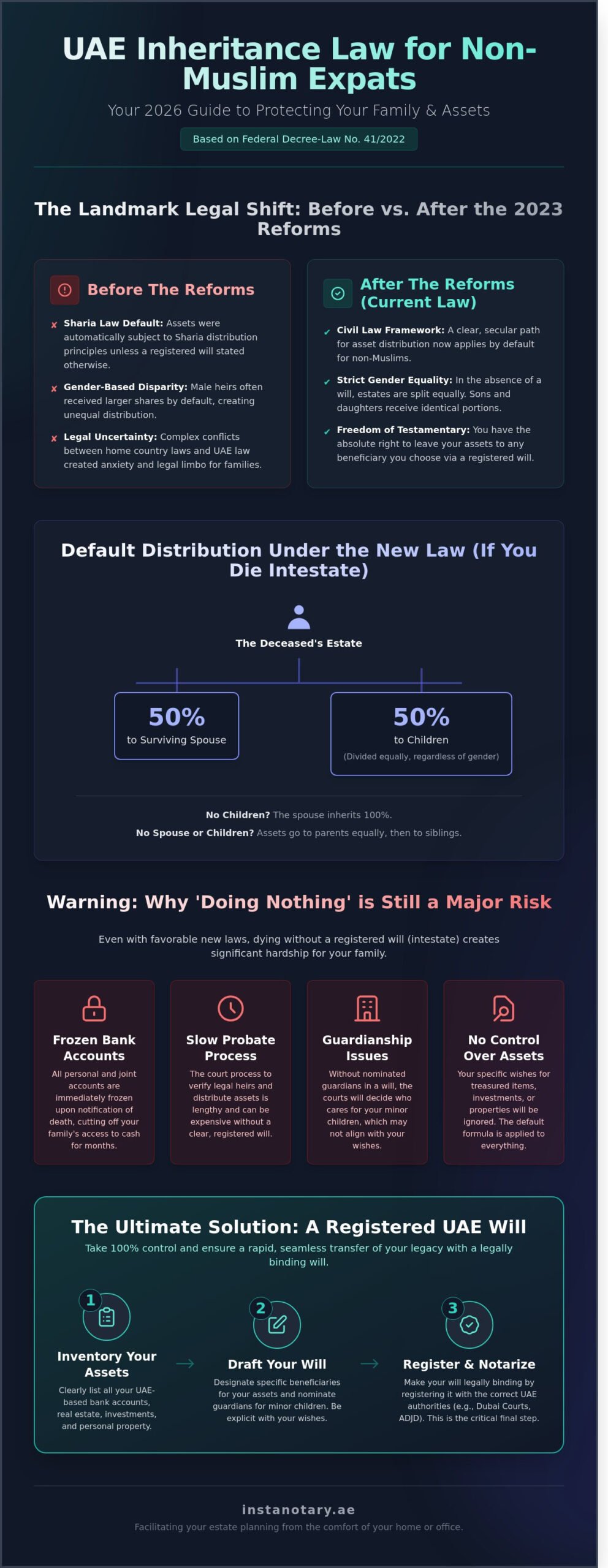
For decades, expat estate planning felt like a complex puzzle. That changed on February 1, 2023. The UAE government introduced Federal Decree-Law No. 41/2022, a landmark piece of legislation that fundamentally altered the landscape for residents. This law provides a civil framework for non-Muslim residents, ensuring your assets aren’t automatically subject to Sharia-based distribution. Understanding the uae inheritance law non muslims is vital for protecting your family’s future in 2026. This modern approach aligns with the UAE’s legal system, which balances traditional values with international standards. It provides a clear, secular path for asset distribution that mirrors many Western jurisdictions.
The Core Principles of the 2022/2023 Reforms
The 2022 reforms introduced strict gender equality in inheritance matters. If a resident dies without a will, the law mandates that the estate is split equally between surviving spouses and children. This removes the previous gender-based disparities where male heirs often received larger shares by default. You also enjoy full “Freedom of Testamentary.” This means you can leave your Dubai or Abu Dhabi assets to any beneficiary you choose through a valid legal document. The law recognizes your right to decide your own legacy. It creates a predictable environment for the millions of expats who call the Emirates home, regardless of whether their assets are physical real estate or digital investments.
Why ‘Doing Nothing’ is Still a Risk
Don’t let the favorable default laws lead to complacency. Even with the 2023 reforms, if you die intestate, the probate process remains slow and potentially expensive. Dubai banks typically freeze all personal and joint accounts immediately upon notification of death. This can leave your family without access to liquid cash for months while the courts verify legal heirs. You might also face complex legal conflicts between the uae inheritance law non muslims and your home country’s regulations.
The only way to ensure 100% control and rapid asset transfer is through a registered will. We facilitate the drafting and notarization of these documents to keep your assets secure and your family protected. A registered document acts as a shield against administrative delays. Reach out to our team at InstaNotary to start your application from the comfort of your office. Taking action now prevents the stress of legal uncertainty later.
Key Provisions of Federal Decree-Law No. 41/2022
Federal Decree-Law No. 41/2022 creates a secular, civil framework that prioritizes the deceased’s intent. Article 11 is the cornerstone of this legislation; it grants non-Muslims the absolute right to designate beneficiaries through a registered will. This shift empowers expats to bypass traditional defaults and ensure their assets reach specific loved ones without legal friction. Understanding these key laws governing inheritance is essential for anyone holding assets in Dubai or Abu Dhabi. It ensures your legacy is handled according to your personal wishes rather than rigid default codes.
If you die without a will, the uae inheritance law non muslims applies a clear formula. The surviving spouse receives 50%, while the remaining 50% is divided equally among the children. If there are no children, the spouse inherits the entire estate. In cases where no spouse or children exist, the law directs assets to the parents in equal shares, followed by siblings. The UAE Ministry of Justice maintains a ‘Civil Register’ to track these legacies. This digital system ensures that the transition of wealth is transparent, secure, and follows the 2022 decree precisely.
Equality in Distribution: A Significant Milestone
The new civil law removes gender-based disparities that previously existed under traditional principles. Sons and daughters now receive identical portions of an estate. This modernization aligns the UAE with international standards, providing a predictable outcome for families. Equal distribution is the 2026 standard for non-Muslims, ensuring that gender does not dictate the size of an inheritance.
Guardianship and Minor Children
Protecting your children is a top priority for any expat. The law allows parents to nominate guardians through a notarized document to ensure custody stays with trusted individuals. While the 2022 law provides a safety net, we recommend drafting separate guardianship declarations to avoid any ambiguity during probate. You can facilitate the preparation of these documents to secure your family’s future instantly. These declarations carry significant legal weight in UAE courts and prevent the state from making custody decisions on your behalf. It’s a seamless way to gain peace of mind from the comfort of your home or office.
Home Country Laws vs. UAE Registered Wills
Expats often believe their home country laws provide a safety net for their assets. While the “Nationality Principle” exists, relying on it creates a heavy administrative burden for your grieving family. Under the UAE inheritance law for non-Muslims, the law of your home country can apply to your movable assets, but the process is rarely seamless. The courts require absolute proof of foreign statutes, which leads to significant delays during an already difficult time.
One of the biggest risks involves UAE real estate. Local courts generally apply UAE law to fixed property located within the country. If you own a villa in Dubai or an apartment in Abu Dhabi, relying on a foreign will or your home country’s intestacy rules is a gamble. Without a registered local will, the distribution of your property remains subject to the court’s interpretation of the law, which may not align with your intentions.
Applying Foreign Law in UAE Courts
If you haven’t registered a local will, your heirs must prove the specific provisions of your home country’s law to the UAE courts. This requires a formal legal opinion from a qualified expert in your home jurisdiction. Every document, from death certificates to foreign court orders, must undergo a rigorous process of document attestation UAE through the Ministry of Foreign Affairs. These legal fees and certified translation costs can easily exceed AED 30,000. The probate process can drag on for 12 to 18 months while these requirements are met.
The Advantages of a DIFC or Civil Will
Registering a local will through the Dubai International Financial Centre (DIFC) or the Abu Dhabi Judicial Department (ADJD) offers a fast-track solution. These frameworks provide 100% certainty that your assets will be distributed according to your specific wishes. You’ll find a detailed comparison of these options in our guide on DIFC Wills vs AD Wills. Key benefits of local registration include:
- Speed of Execution: Assets can often be distributed in a matter of weeks rather than years.
- Cost-Benefit: While registration fees for a DIFC Will start at approximately AED 10,000, this is a one-time investment that saves your family from much higher probate costs later.
- Asset Protection: A local will ensures that your UAE bank accounts and properties aren’t frozen for extended periods.
Choosing a local will is the most efficient route for Dubai residents. It replaces the uncertainty of foreign law with the legal validity of the UAE’s modern civil framework. We facilitate the drafting and preparation of these documents to ensure they meet all Ministry of Justice standards. You can start this process from the comfort of your home or office, ensuring your legacy is protected without the traditional legal stress. This proactive approach is the only way to guarantee that the uae inheritance law non muslims works in your favor.
Essential Steps to Protect Your Dubai Assets
Securing your legacy under the uae inheritance law non muslims framework requires more than just good intentions. It demands a structured approach to ensure your Dubai-based assets remain protected and transition smoothly to your loved ones. The 2022 Decree Law provides the legal foundation, but the execution rests on your proactive planning. You don’t want your family to face frozen bank accounts or lengthy court battles because of a lack of preparation.
First, conduct a comprehensive audit of your UAE holdings. This list should include real estate title deeds for properties in areas like Dubai Marina or Palm Jumeirah, bank account details, investment portfolios, and company share certificates. By 2026, digital asset tracking has become standard, so ensure your inventory includes any local digital business interests or brokerage accounts. Once you’ve mapped your estate, the next step is drafting a document that stands up to legal scrutiny.
Drafting for Legal Validity
DIY wills often fail because they contain contradictory clauses or fail to account for the specific requirements of the 2022 Decree Law. A common pitfall is using vague terminology that leads to court rejection during the probate stage. You must use clear, unambiguous language that explicitly states your wishes regarding your assets. To avoid these risks, you should consult with a facilitator to ensure your document is fully compliant with current regulations. This professional oversight prevents administrative delays and ensures your family doesn’t face unnecessary legal hurdles. Our team helps you draft a will that reflects the latest uae inheritance law non muslims updates, giving you total peace of mind.
The Notarisation and Registration Process
Dubai has pioneered a digital-first approach to legal documentation. In 2026, the notarisation process is almost entirely paperless, allowing you to secure your assets from the comfort of your home or office. This modern system replaces the slow, paper-heavy methods of the past with a fast-paced, secure digital identity verification process.
- Step 1: Document Preparation. Gather your original passport, Emirates ID, and proof of assets such as title deeds or bank statements.
- Step 2: Digital Upload. Submit your drafted will through our secure portal for a professional review to ensure all legal markers are met.
- Step 3: Identity Verification. Complete a brief video call or biometric verification through the official digital channels to confirm your identity.
- Step 4: Final Registration. Once notarised, the document is registered with the appropriate authorities, such as the Dubai Courts or the DIFC Wills Service Centre.
The timeline for full registration is now more efficient than ever, typically taking between 3 to 5 business days. After registration, communicate your plan clearly to your chosen executors. They need to know how to access the registered documents to ensure a seamless transition. This transparency reduces stress for your heirs and ensures your wishes are respected without delay.
Ready to secure your family’s future? Explore our document facilitation services to start your application today.
How InstaNotary Facilitates Your Estate Planning in Dubai
Protecting your assets under the uae inheritance law non muslims requires more than just intent; it requires technical precision. InstaNotary operates as a premium private facilitator, transforming a high-stakes legal hurdle into a managed, professional experience. We focus on stripping away the intimidation factor that often accompanies UAE legal procedures, replacing it with a service-oriented approach that values your time. By choosing a private facilitator, you bypass the friction of navigating government portals alone, ensuring your documentation is compliant with the latest 2026 standards before it’s finalized.
Our role is to act as your “Efficient Expert,” bridging the gap between complex local regulations and your need for speed. While government-only routes often involve a steep learning curve and repetitive administrative steps, our process is designed to be punchy and direct. We handle the heavy lifting of document preparation, so you don’t have to worry about technical rejections or delays that can take weeks to resolve in the traditional system.
Our Specialist Facilitation Services
Our team provides deep expertise in preparing the specific documents required to secure your family’s future. We specialize in assisting clients with a Special Power of Attorney for estate management, which is a critical tool if you need a trusted representative to manage properties or bank accounts. We also handle the intricate drafting required for the DIFC Wills Service Centre or the Abu Dhabi Civil Wills register. Every document we facilitate is prepared to meet the rigorous UAE Ministry of Justice standards, ensuring your legacy is built on a foundation of absolute legal validity.
- Will Drafting Support: We prepare personalized drafts that reflect your specific distribution wishes for your Dubai assets.
- POA Preparation: We ensure your powers of attorney are limited or broad enough to meet your exact needs without legal ambiguity.
- Document Coordination: We facilitate the necessary steps for legal validity, including coordinating with translators for official Arabic versions.
Seamless Experience from Home or Office
The InstaNotary model is built on digital convenience. We understand that Dubai expats lead busy lives, so we’ve designed a process that allows you to manage your estate planning from the comfort of your home or office. Our digital-first notarization support means we provide the guidance you need through the maze of 2026 UAE inheritance regulations without the dry, archaic language of traditional law firms. We offer a one-stop solution where legal rigor meets modern accessibility, ensuring your documents are prepared and ready for use in record time.
Don’t leave your estate to chance or allow complex bureaucracy to delay your planning. Our team is ready to provide the professional, authoritative support you need to navigate the uae inheritance law non muslims with total confidence. Secure your legacy in Dubai with InstaNotary today and experience the speed of a truly modern legal facilitator.
Secure Your Dubai Legacy and Protect Your Family’s Future
Navigating uae inheritance law non muslims requires a proactive approach to ensure your assets are handled according to your wishes. Federal Decree-Law No. 41/2022 provides a robust framework for expats, yet the most reliable way to avoid legal ambiguity is through a registered UAE will. This legal document acts as a shield for your Dubai real estate, bank accounts, and investments. It prevents the application of default home country laws that might not align with your specific intentions. At InstaNotary, we serve as your expert facilitators for UAE Ministry of Justice compliant documents. Our specialists focus on expat estate planning to provide a fast, secure, and professional digital service. We’ve replaced slow, paper-heavy traditional methods with a streamlined process you can complete from your home or office. Taking these essential steps now ensures your loved ones are protected from unnecessary administrative burdens later. It’s the most responsible decision you can make for your life in the UAE.
Start Protecting Your UAE Assets Today with InstaNotary
Your peace of mind is our priority, and we’re here to make your legal journey seamless and certain.
Frequently Asked Questions
Does Sharia law apply to non-Muslims in the UAE in 2026?
No, Sharia law does not automatically apply to the estates of non-Muslims in 2026. Since the implementation of Federal Decree-Law No. 41 of 2022, the UAE uses a dedicated civil law framework for non-Muslim expats. This system respects the personal status of the 8.8 million expats living in the country. It provides a secular alternative for inheritance, ensuring your assets are handled according to modern civil principles rather than religious codes.
What happens to my Dubai bank account if I die without a will?
Your Dubai bank accounts are typically frozen the moment the authorities are notified of a death. If you die intestate, the UAE courts distribute your funds according to the default ratios set in the 2022 Civil Law. This means the court determines the heirs, which often leads to delays in accessing cash for funeral costs or family maintenance. Joint accounts don’t automatically transfer to the survivor; they stay frozen until the court issues a succession certificate.
Can I apply the inheritance law of my home country to my UAE assets?
Yes, you can choose to apply the laws of your home country to your estate by documenting this choice in a registered will. Under the current uae inheritance law non muslims, you have the legal right to opt for the law of your nationality. You must ensure your will is professionally drafted, translated into Arabic, and properly notarized. This choice provides certainty for your family and prevents the default UAE civil laws from taking precedence over your wishes.
What is the difference between a DIFC will and a local UAE will?
A DIFC will is registered through the Dubai International Financial Centre and operates under English Common Law principles. It’s a popular choice for expats who want a familiar legal framework for their assets. A local UAE will, or a “Civil Will,” is registered through the Dubai Courts or the Notary Public. Both options are 100% legally binding across all emirates, but the DIFC route offers a fully digital registration process that many find more convenient.
How is inheritance divided for non-Muslims if there is no will?
If no will exists, the estate is divided based on the civil rules established in early 2023. Typically, the surviving spouse receives 50% of the assets. The remaining 50% is split equally among the children, regardless of their gender. If the deceased had no children, the remaining half usually goes to the parents. This equal distribution is a major shift from previous years and provides a predictable outcome for the 200 nationalities living in Dubai.
Is a foreign will valid for real estate in Dubai?
A foreign will is valid but requires a complex and expensive attestation process before the Dubai Land Department will recognize it. You must have the document legalized in your home country, attested by the UAE Embassy there, and then cleared by the UAE Ministry of Foreign Affairs. These steps often cost over AED 5,000 and take several weeks. Most residents prefer to facilitate a local will to avoid these hurdles and ensure a seamless transfer of property.
How long does the probate process take in Dubai for non-Muslims?
The probate process in Dubai generally takes between 3 and 9 months to complete. If you have a clearly registered will, the courts can issue a succession order much faster. Without a will, the timeline often extends beyond 12 months as the court must verify all legal heirs and translate various foreign documents. Using a professional service to prepare your documentation helps you avoid common mistakes that cause these administrative bottlenecks.
Do I need to hire a lawyer to write a will in Dubai?
You aren’t legally required to hire a lawyer, but it’s highly recommended to ensure your document complies with the latest uae inheritance law non muslims. Small errors in wording or registration can lead to the court rejecting the document during the probate stage. A professional facilitator ensures your will is legally binding, correctly translated, and registered with the proper authorities. This small investment protects your assets and gives your family peace of mind during a difficult time.