What Does a Notary Do? A Guide to Notary Services in Dubai (2026)
By / March 24, 2026
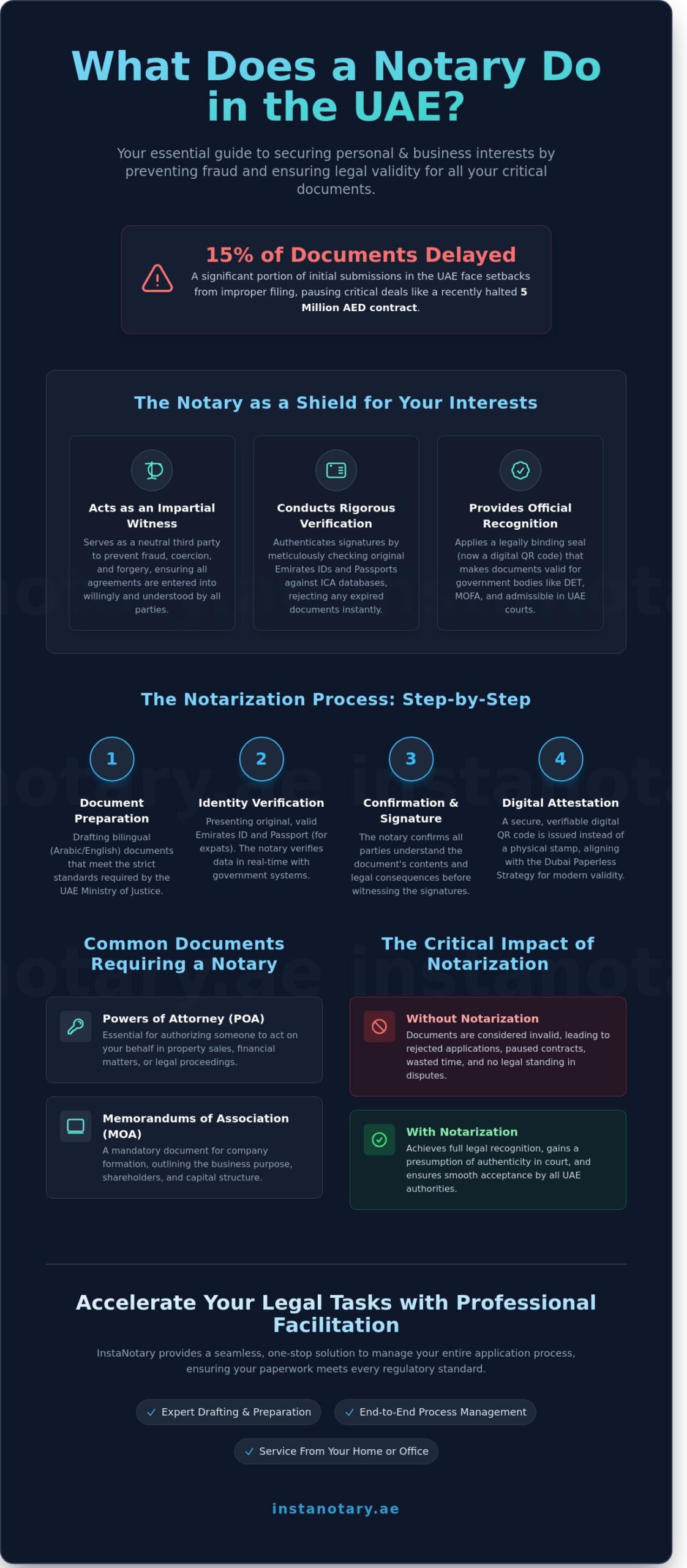
On March 12, 2026, an entrepreneur in Business Bay discovered that a 5 million AED contract was effectively paused because of a missing attestation. It’s a stressful realization that many professionals face, as roughly 15% of initial document submissions in the UAE encounter delays due to improper filing. Understanding what does a notary do is essential to avoiding these setbacks within the UAE’s rigorous legal framework. You likely feel that navigating local bureaucracy is a daunting task, especially when a single error leads to rejected applications and wasted hours at government counters.
We understand that your time is your most valuable asset in Dubai’s competitive economy. This guide promises to clear the confusion by detailing how a notary acts as a vital shield for your personal and business interests. You’ll learn which specific documents require a seal, the legal power behind a notarized signature, and how Insta Notary Services provides a seamless, one-stop solution to get your paperwork ready for the Ministry of Justice from the comfort of your home or office.
Key Takeaways
Understand exactly what does a notary do to protect your personal and business interests by acting as an impartial witness to prevent fraud in the UAE.
Learn the rigorous verification steps required for Emirates IDs and corporate licenses to ensure every signature is legally binding and fully authorized.
Identify the essential documents that require notarization in Dubai, from Powers of Attorney for property sales to Memorandums of Association for company formation.
Navigate the step-by-step process of preparing bilingual documents that meet the strict standards of the UAE Ministry of Justice.
Discover how professional facilitation can accelerate your legal tasks, allowing you to secure your documentation with expert guidance from the comfort of your home or office.
The Role of a Notary Public in the Dubai Legal System
In the fast-paced business environment of Dubai, document integrity is the foundation of every transaction. If you’ve ever wondered what does a notary do, the answer lies in their status as an authorized official who serves as a neutral third party. Their primary job is to verify identities and ensure that every signature on a legal document is authentic and given voluntarily. This process creates a layer of security that prevents fraud and protects the interests of all parties involved in a contract or agreement. You’ve likely encountered this requirement when setting up a business or selling property, as it’s the standard for high-stakes documentation in the UAE.
Understanding the role of a notary public is essential because it bridges the gap between private agreements and state recognition. In the UAE, notarization isn’t just a formality; it’s a mandatory legal requirement for documents to be accepted by the Department of Economy and Tourism (DET) or the Ministry of Foreign Affairs (MOFA). Without this step, your Power of Attorney or Memorandum of Association holds no weight in the eyes of the government. By confirming what does a notary do, you realize they’re the gatekeepers of legal validity, ensuring that every document entering the public record is legitimate and binding.
It’s vital to distinguish between the entities involved in this process. While a public notary is a government official within the Dubai Courts, a private service facilitator like InstaNotary acts as your expert partner. We assist you by preparing, drafting, and managing the entire application process from start to finish. We don’t just provide information; we facilitate the entire journey, ensuring your paperwork meets every specific regulatory standard before it reaches the final stage of attestation. This one-stop solution allows you to handle complex legalities from the comfort of your home or office.
Why Impartiality Matters in UAE Law
Impartiality is the backbone of legal trust. A notary ensures that no party is being forced into an agreement against their will. They verify that everyone signing the document fully understands the legal consequences of their actions. This preventative measure stops future claims of forgery or coercion before they can start. In the context of Dubai Courts, an impartial witness is a neutral official who verifies the identity of signers and confirms their willing participation without having any personal interest in the document’s outcome. This neutrality ensures that the document remains beyond reproach in a court of law.
The Legal Weight of a Notary Seal in Dubai
A notarized document carries a heavy presumption of authenticity in UAE courts. This means the court accepts the document as genuine unless proven otherwise, which is a significant advantage in any legal dispute. Banks, real estate developers, and government entities require this seal because it guarantees that the transaction is legitimate. Since the 2021 implementation of the Dubai Paperless Strategy, the system has evolved significantly. Old-fashioned physical stamps have largely been replaced by modern digital QR codes. These codes allow any authority to instantly verify the document’s validity through a secure online portal, combining legal validity with digital convenience. This tech-forward approach ensures your documents are secure, verifiable, and ready for immediate use across the Emirates.
Core Responsibilities: What a Notary Does During an Appointment
When you attend a session, whether it’s a physical meeting or a digital call, you might wonder exactly what does a notary do to make your paperwork legally valid. The process is a structured sequence of verification steps designed to prevent fraud and ensure that every document can withstand legal scrutiny in a UAE court. It’s a high-stakes role that balances administrative precision with legal oversight to protect all parties involved in a transaction.
Identity Verification Protocols
The first and most critical step involves a rigorous check of your identity. For UAE nationals, the original Emirates ID is the gold standard. Expats are required to present both their original Emirates ID and a valid passport. Notaries in Dubai and across the Emirates now utilize integrated digital systems from the Federal Authority for Identity and Citizenship (ICA) to verify data in real time. If a document has expired by even a single day, the notary will immediately reject the act. This strictness is a core part of what does a notary do to maintain the integrity of the UAE legal system.
Ensuring Competence and Understanding
A notary acts as a gatekeeper for legal capacity. They must be certain that every signer is of sound mind and has reached the legal age of 21, which is the standard for full capacity in the UAE. If there’s any suspicion that a person is under duress or doesn’t fully grasp the obligations they’re signing into, the notary is legally obligated to halt the process immediately.
Language is a common hurdle in the UAE’s diverse business environment. Since Arabic is the official language of the legal system, any document drafted in English or another language requires a certified legal translation from a provider licensed by the Ministry of Justice. Professional facilitators often assist in preparing documents to ensure they meet these specific linguistic and structural standards before the appointment even begins.
Verification of authority is another essential layer of the process. If you’re signing on behalf of a corporation, the notary will meticulously review the company’s Trade License and any existing Power of Attorney. This confirms that you have the specific legal right to bind the company to the agreement. This level of detail is necessary for the attestation of official documents that are often required for international business dealings or government applications.
The final responsibility is record keeping. Every notarial act is recorded in a secure, permanent log. In the UAE, this has shifted toward digital registries that provide a transparent and tamper-proof trail of the transaction. This log serves as a vital reference point if the document’s authenticity is ever questioned in the future. It’s this combination of identity checks, authority verification, and permanent recording that gives a notarized document its “probative value,” meaning it’s accepted as authentic evidence in legal proceedings.
Ensuring your documents meet these strict requirements can be complex, but you can book a pre-verification check to ensure your appointment goes smoothly and without delays.
Common Documents Requiring Notarization in the UAE
Understanding what does a notary do involves looking at the specific documents they handle daily to keep the UAE’s legal and commercial sectors moving. Notarization acts as a shield against fraud; it ensures that every signature on a high-stakes document is genuine and voluntary. In a fast-paced market like Dubai, where property deals and business setups happen hourly, the notary is the essential gatekeeper of legal validity.
The Power of Attorney (POA) is the most requested document in our region. It allows an individual or entity to appoint a representative to act on their behalf. In the UAE real estate sector, a notarized POA is mandatory if you aren’t physically present to sign a Sales and Purchase Agreement at the Dubai Land Department. This document is equally vital for vehicle sales and company management. Without a notarized POA, your representative lacks the legal standing to interact with government bodies or utility providers.
For entrepreneurs, the Memorandum of Association (MOA) is the foundation of any Limited Liability Company (LLC). When you form a company or assign shares, the MOA must be notarized to be recognized by the Department of Economy and Tourism (DET). This process confirms that all partners agree to the terms of the business structure. Similarly, Board Resolutions are necessary for corporate governance. Banks in the UAE typically require a notarized resolution before they’ll open a corporate account or authorize new signatories for a business facility.
Corporate and Business Documentation
Businesses often require specialized notarization for LLC Share Sale Agreements and Local Service Agent Agreements. These documents formalize the relationship between partners and ensure compliance with the UAE Commercial Companies Law. A critical part of what does a notary do for businesses is verifying Signature Specimens. Banks and government agencies require these verified signatures to prevent unauthorized transactions on corporate accounts. If you’re looking to streamline your company’s legal paperwork, you can view our full list of corporate services to see how we facilitate these essential filings.
Personal and Family Legal Documents
Personal legal needs in the UAE often center on family safety and financial clarity. Travel consent forms for minors are a prime example. Dubai International Airport and other UAE ports of entry frequently require notarized permission if a child is traveling with only one parent or a guardian. This measure prevents international parental child abduction and ensures the child’s safety. We also assist with attesting utility bills and DEWA statements. These are often required by foreign embassies or international banks as proof of residency in the UAE.
Another vital document is the Acknowledgement of Debt. In personal lending scenarios, having a notarized statement where the borrower formally admits the debt provides the lender with a powerful legal instrument. This document simplifies the recovery process through the UAE courts if a dispute arises. Our role is to ensure these documents are drafted clearly and meet the specific formatting requirements of the local authorities. We focus on making these high-stakes personal matters feel secure and straightforward for every client.
The Notarization Process in Dubai: Step-by-Step
The notarization process in Dubai follows a strict legal sequence to ensure every document is enforceable and recognized by UAE authorities. When clients ask what does a notary do, the answer lies in this precise four-stage verification cycle. It’s a journey that transforms a private agreement into a powerful legal instrument. At InstaNotary, we facilitate this entire workflow to ensure your documents meet every regulatory benchmark without the typical administrative friction.
Preparation and Drafting: Your document must align with the latest UAE Ministry of Justice templates. Since 2023, standardizing clauses has become essential for approval. We assist in drafting Power of Attorney (POA), Board Resolutions, and Memorandums of Association that comply with local statutes.
Legal Translation: The UAE requires all notarized documents to be in a bilingual Arabic and English format. This isn’t just a simple translation; it’s a specialized legal rendering performed by licensed translators registered with the Ministry of Justice.
Appointment and Witnessing: This is the moment of execution. The notary verifies the identity of all signatories using original Emirates IDs or passports. You’ll confirm your understanding of the document and sign it in the presence of the official, either physically or via a secure digital link.
Final Attestation: Once signed, the document receives the official government seal and a unique QR code. This digital anchor allows any third party to verify the document’s authenticity instantly by scanning it, ensuring global and local legal validity.
Our team provides the expert oversight needed to navigate these steps efficiently. You can start your notarization application online today to skip the queues and secure your legal standing.
Digital vs. Physical Notarization in 2026
By 2026, the ‘Dubai Courts’ video call system and the Botim integration have completely revolutionized how we handle legal paperwork. You no longer need to fight traffic to reach a government office. Instead, most notarizations happen via a secure video conference where you present your ID to the camera. This digital shift relies heavily on the UAE Pass app for identity authentication. However, physical presence is still mandatory for specific high-value transactions, such as property transfers exceeding AED 5 million or certain complex corporate restructuring cases. We’ll advise you on which path your specific document requires.
Avoiding Common Delays and Rejections
The primary reason documents are rejected in Dubai is incorrect drafting or missing mandatory clauses required by the Ministry of Justice. Even a small error in a company’s name or a missing passport number can stall the process for weeks. It’s also vital to understand that ‘True Copy’ attestation is a separate process from notarization. While notarization validates a signature on a new document, a True Copy service confirms that a photocopy is an exact match of an original certificate. Fees for government notarization may vary depending on the document value, so it’s best to have a clear fee structure before you begin. We act as your quality control layer, catching these issues before they reach the notary’s desk. This proactive approach ensures a seamless experience from the comfort of your home or office.
Why Professional Facilitation is Essential for Your Legal Documents
Attempting to handle complex legal paperwork alone often leads to avoidable delays and administrative friction. While understanding what does a notary do is the first step, executing the process with precision requires a deep familiarity with local protocols. In the UAE, a single missing clause in a Power of Attorney or an incorrectly formatted Board Resolution can result in immediate rejection by the Ministry of Justice. Professional facilitation ensures your documents are drafted to meet strict legal standards before you ever step into a digital or physical signing room. This proactive approach saves you from the frustration of repeated applications and the high costs of legal errors.
Speed remains a top priority for investors and residents alike. A typical self-managed notarization might take five working days when accounting for drafting mistakes and appointment backlogs. With expert facilitation, this timeline often shrinks to under 24 hours. We pre-vet every page to ensure compliance with the specific regulations of the relevant emirate. Whether you’re dealing with the Dubai Department of Economy and Tourism or federal authorities, having a submission-ready file is the only way to bypass the queue. Research suggests that 85% of corporate document rejections in Dubai Free Zones stem from minor formatting issues that could have been caught during a pre-vetting stage.
Strategic communication with government portals is another area where facilitation provides immense value. The UAE has transitioned toward a digital-first legal system, utilizing platforms like Botim and the MOJ portal for remote notarization. These systems require specific file sizes, precise document naming conventions, and verified digital signatures. We handle these technical hurdles on your behalf, reducing the stress associated with potential technical glitches. Instead of managing the upload process yourself, you benefit from a streamlined workflow that guarantees your application reaches the right official in the correct format the first time.
Ultimately, professional facilitation is an investment in your legal security. When you realize what does a notary do for your peace of mind, the value of an expert partner becomes clear. It transforms a bureaucratic task into a strategic asset, ensuring your documents aren’t just signed, but are also legally robust and enforceable. This protection is vital when managing assets or making corporate commitments that involve significant financial stakes, often reaching millions of AED.
The InstaNotary Advantage
We specialize in the preparation of complex instruments like General Powers of Attorney and Board Resolutions. Our team ensures your documents are submission-ready by aligning them with the latest UAE Ministry of Justice updates. You receive expert advice during the drafting phase, which is much more effective than finding out your document is invalid at the final signing stage. We bridge the gap between technical law and digital convenience, providing a premium concierge experience for all your legal needs.
Start Your Notarization Journey Today
Don’t risk your legal validity by using generic templates or unverified drafts. For busy professionals in Dubai, our digital-first approach provides the elite service you expect without the traditional wait times. We handle the administrative heavy lifting so you can focus on your business or personal commitments. Secure your legal interests with a partner who understands the local landscape inside out. Contact InstaNotary now for a seamless facilitation experience.
Take Command of Your Dubai Legal Requirements
Understanding what does a notary do is the vital first step toward protecting your personal and corporate interests in the UAE. By 2026, the Dubai legal landscape has shifted toward a sophisticated digital-first model, requiring strict adherence to UAE Ministry of Justice standards for every power of attorney, affidavit, or commercial contract. You don’t have to navigate these complex regulatory frameworks alone. Our team provides premium concierge-level legal support to ensure your documents meet every local requirement without the typical administrative delays. We focus on fast-track processing for corporate and personal files, transforming a potentially stressful government procedure into a seamless digital experience. Whether you’re an international investor or a local business owner, getting your paperwork right the first time saves you both time and significant amounts of AED in potential correction fees. You deserve a one-stop solution that prioritizes legal validity and your convenience from the comfort of your home or office. Our experts are ready to facilitate your journey through the Dubai legal system with absolute precision. High-stakes documentation requires an efficient expert who understands the nuances of local law.
Your peace of mind is our priority, so let’s get your documents finalized correctly today.
Frequently Asked Questions
Is a private notary the same as a government notary in Dubai?
Yes, a private notary has the same legal authority as a government notary to attest and witness documents. The Dubai Courts and the UAE Ministry of Justice license private notaries to provide these services with more flexibility. While government offices follow fixed hours, private notaries often offer extended timings and digital solutions to suit your schedule. We facilitate these connections to help you skip the long queues at public service centers.
Can a notary public give legal advice on my document?
No, a notary public isn’t authorized to provide legal advice or review the fairness of your agreement. Their primary duty is to verify your identity and ensure you’re signing the document of your own free will. If you’re unsure about the legal implications of a contract, you’ll need to consult a lawyer before the appointment. Our team can assist you by ensuring your documents are drafted according to the latest UAE regulatory standards.
What happens if I sign a document before meeting the notary?
You shouldn’t sign your document until you’re in the presence of the notary, as they must witness the act of signing to verify it’s authentic. If you’ve already signed it, the notary will likely ask you to sign a fresh copy or sign it again in front of them. This protocol is a critical security measure that prevents identity theft and ensures the document’s legal validity in UAE courts.
How long does the notarization process take in Dubai?
The actual signing process typically takes between 10 and 20 minutes once you’ve started your session with the notary. When considering what does a notary do to save you time, they now utilize digital tools like the UAE Pass for instant identity verification. This modern approach can reduce the total turnaround time for many documents to under 90 minutes, allowing you to complete your legal requirements without leaving your office.
Do I need to be physically present in the UAE to notarize a document?
You don’t need to be physically present in the country thanks to the UAE’s advanced remote notarization systems. By using a secure video call and the UAE Pass app, you can complete the entire process from anywhere in the world. This digital convenience is especially beneficial for international investors who need to manage their UAE assets without the 7 hour flight to Dubai.
What is the difference between notarization and MOFA attestation?
Notarization is the first step where a notary verifies your signature; MOFA attestation is a final step that makes the document legally valid for international use. Notarization fees often start around AED 300, while the Ministry of Foreign Affairs (MOFA) charges approximately AED 160 for personal document attestation. We provide a one-stop solution by assisting with both steps so your paperwork is ready for use locally and abroad.
Can a notary refuse to notarize my document?
Yes, a notary will refuse to sign if they suspect fraud, if the signer lacks mental capacity, or if the document contains illegal clauses. They also won’t proceed if the document’s content contradicts UAE public policy or moral standards. Our experts help you prepare your paperwork to pass all 15 standard compliance checks, ensuring a seamless experience when you finally meet the notary.
Is an online notarization legally binding in the UAE?
Yes, online notarization is 100% legally binding and recognized under UAE Federal Law No. 11 of 2021. Documents signed via digital platforms carry the same weight as those signed with a pen in a traditional court office. This shift toward digital transformation provides you with a secure, encrypted, and efficient way to handle high-stakes documentation from the comfort of your home.