
Last Tuesday, a business owner in Dubai realized their AED 50,000 invoice payment was nothing more than a piece of paper with an “insufficient funds” stamp. It’s a gut-wrenching moment that leaves you wondering if your hard-earned money has vanished, especially if you haven’t yet issued a cheque bounce legal notice to protect your rights. You’ve likely heard that UAE laws have shifted, and you might fear that decriminalization has left you without a clear path to recovery.
It’s stressful to deal with a debtor who goes silent while your own business expenses continue to pile up. However, the 2026 legal landscape actually offers a faster route to your funds than the traditional court system ever did. By following the right steps, you can leverage direct execution laws to turn that bounced cheque into a legally binding demand that banks and authorities must respect.
This guide explains the exact process for serving a valid notice and navigating the streamlined UAE recovery system. We’ll show you how to move straight to freezing a debtor’s bank accounts or seizing assets, ensuring your unpaid invoices are settled without the headache of a long-term legal battle.
Key Takeaways
- Understand how UAE Decree-Law No. 14/2020 accelerates fund recovery by establishing the cheque as an instantly enforceable executive deed.
- Learn how to draft and serve a professional cheque bounce legal notice that meets all mandatory legal criteria for the Dubai Execution Court.
- Identify the critical information required—from the date of dishonor to specific bank details—to ensure your notice is served without procedural errors.
- Explore the streamlined process of moving directly to the Execution Judge if the 15-day grace period expires without payment.
- Gain the confidence to handle high-stakes financial recovery using the UAE’s modern, direct execution framework for faster results.
Understanding UAE Cheque Laws: Decriminalization vs. Direct Execution
Your cash flow just hit a brick wall because a client’s cheque bounced. It’s a common frustration in Dubai’s fast-paced market, but the legal landscape has shifted heavily in your favor. By 2026, the provisions of Federal Decree-Law No. 14/2020 have fully matured, creating a streamlined path for fund recovery. The Legal system of the United Arab Emirates now prioritizes civil restitution over criminal prosecution, which means you get your money back faster.
The most significant change is the ‘Cheque as an Executive Deed’ concept. You don’t have to endure a grueling trial that lasts months or years. Instead, ‘Direct Execution’ allows you to take a bounced cheque straight to the Execution Court. While this power is immense, serving a formal cheque bounce legal notice is still your vital first step. It acts as a professional ultimatum that often triggers immediate payment, saving you the 5% to 10% in court fees associated with formal execution filings.
When is a Bounced Cheque Still a Criminal Offense?
Criminality isn’t entirely off the table. It’s reserved for instances of “bad faith.” If a drawer intentionally closes their account before the cheque is presented or provides a signature they know won’t match, they’ve crossed into criminal territory. You can report these specific fraud cases through the Dubai Police ‘Eye’ app. This digital tool allows you to flag suspicious financial behavior instantly, though it doesn’t replace the need for a cheque bounce legal notice to recover the actual funds.
The Power of the ‘Executive Deed’ in Dubai Courts
Your bounced cheque is now essentially a court judgment in your pocket. Under the current regulations, the cheque itself grants you the right to request asset freezes and travel bans against the debtor without a preliminary hearing. To make this process seamless, you must ensure your documentation is verified. Linking your claim with a notary public Dubai for attestation ensures your paperwork meets the strict standards of the Execution Court. This high level of verification prevents technical delays and moves you to the front of the recovery line.
Ready to reclaim your funds? Contact our experts today to draft a professional notice that gets results.
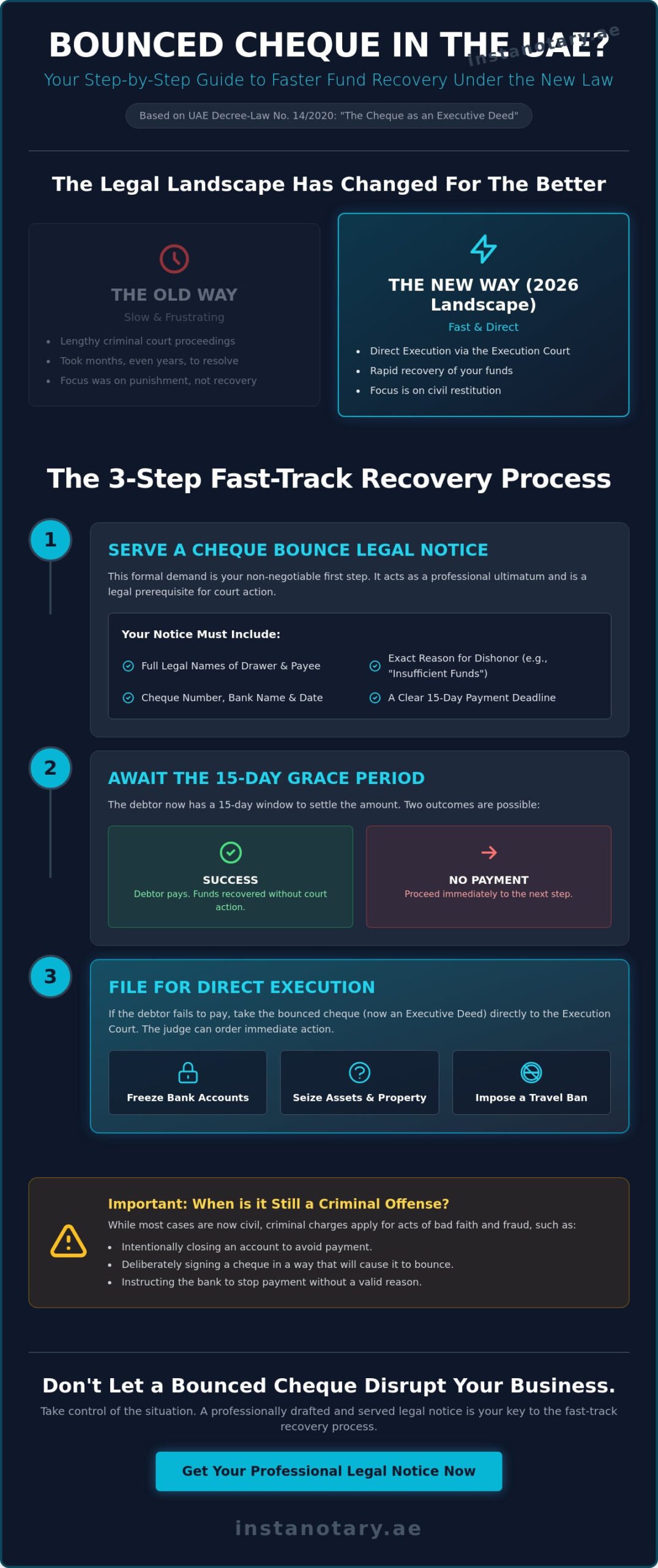
How to Draft and Serve a Cheque Bounce Legal Notice in Dubai
You’ve waited long enough for a payment that hasn’t arrived. Holding a dishonored cheque is frustrating, but it’s also a powerful legal tool if you handle it correctly. Drafting a cheque bounce legal notice isn’t just a formality; it’s a strategic demand that sets the stage for fund recovery. To ensure your notice is airtight under UAE law, you must follow a specific, four-step protocol.
- Step 1: Identify the Parties. Use the full legal names of both the Drawer (the person who signed the cheque) and the Payee (you or your company) as they appear on official documents like trade licenses or Emirates IDs.
- Step 2: Detail the Instrument. Explicitly reference the cheque number, the specific bank name, and the exact date the cheque was presented and subsequently dishonored.
- Step 3: Cite the Bank Memo. State the exact reason for the return as listed on your “Cheque Return Memo.” Whether it’s “Insufficient Funds” or “Account Closed,” accuracy here is non-negotiable.
- Step 4: Set a Deadline. Grant a specific 15-day grace period for the debtor to settle the full amount. This timeframe is the standard window for settlement before further legal action is triggered.
Mandatory Contents of Your Legal Notice
The “Demand for Payment” clause must be clear and assertive. It shouldn’t just ask for the funds; it should demand immediate payment of the principal amount plus any applicable costs. You must include a warning that failure to comply will lead to a direct route to the execution judge. This warns the debtor of impending travel bans and asset freezes. For business-related debts, ensure the language meets the strict criteria of corporate notary services Dubai to maintain legal validity during court proceedings.
Why Serving via Private Notary Matters
A simple email or WhatsApp message is easy to ignore. A Notary-stamped cheque bounce legal notice carries the weight of the law. When you serve your notice through a professional platform like InstaNotary, you eliminate the debtor’s ability to claim “non-receipt” in court. Our digital-first approach ensures your notice is delivered and recorded with absolute precision. It’s the most efficient way to prove you’ve exhausted all amicable options. If you need help drafting a compliant notice that commands attention, you can contact us to start the process today.
Steps After the Notice: Moving to Dubai Execution Court
You sent the legal notice. The 15-day deadline passed. Your phone remains silent. This is when the Dubai Execution Court becomes your strongest ally. Since the 2021 amendments to the UAE Commercial Transactions Law, a bounced cheque acts as an “Executive Instrument.” You don’t need a lengthy, expensive lawsuit to prove the debt. Instead, you file the cheque directly with the Execution Judge to start immediate recovery. It’s a fast-track system designed to protect creditors.
The court has teeth. It can freeze the debtor’s bank accounts, seize registered vehicles, and block properties. If you’re busy or living abroad, a power of attorney UAE allows a legal representative to handle these filings on your behalf. This keeps the process moving while you focus on your business. Most recovery actions through the Execution Court see movement within weeks rather than months.
Applying for Precautionary Measures
Recovery isn’t just about waiting for a judge to rule. You can request a “Performance Order” to secure your funds quickly. This includes asking for an immediate travel ban on the debtor. It prevents them from leaving the country before the debt is settled. These measures create significant pressure, often forcing a settlement before assets are even auctioned. It’s about securing the money before it disappears.
Common Mistakes to Avoid in Cheque Recovery
Time is your biggest enemy. You must present the cheque to the bank within 6 months of its date. Once it bounces, the statute of limitations for filing a cheque bounce legal notice and subsequent execution is 2 years. Waiting longer can extinguish your legal rights entirely. Don’t let a debtor stall you with empty promises until your time runs out.
- Accepting partial payments: Don’t accept small amounts without a written, notarized settlement agreement. This protects your right to claim the remaining balance.
- Losing the Memo: Never lose the original Cheque Return Memo. The bank provides this document when the cheque fails; the court won’t proceed without this physical proof.
- Inaccurate data: Ensure the debtor’s Emirates ID or trade license details are correct before filing to avoid administrative delays.
The process is straightforward but requires precision. If you’re unsure how to draft your documents or need assistance with the next steps, reaching out to a professional facilitator can save you hours of technical frustration. Ready to recover your funds? Contact us today for expert guidance on your next steps.
Secure Your Funds with a Professional Legal Strategy
Recovering your money shouldn’t feel like a second job. Since the implementation of UAE Decree-Law No. 14/2020, the path to fund recovery has become significantly faster for those who understand the shift toward direct execution. You don’t have to navigate the complexities of the Dubai Execution Court alone. A professionally drafted cheque bounce legal notice serves as your first and most vital step in establishing a clear legal claim. It signals your intent and often resolves the dispute before it ever reaches a judge’s desk.
InstaNotary simplifies this high-stakes process by providing expert drafting that’s fully compliant with current UAE regulations. We offer fast notarization and precise delivery tracking so you’re never left wondering about the status of your case. We’re your one-stop solution for all essential UAE legal documents, handling the technical details while you focus on your business. Don’t let unpaid debts stall your progress.
Start your Cheque Bounce Legal Notice with InstaNotary today and regain control of your finances. You’ve worked hard for your capital; we’ll help you protect it.
Frequently Asked Questions
Is cheque bouncing still a criminal offense in the UAE in 2026?
Most cheque bounce cases are now handled as civil matters following Decree Law No. 14 of 2020. Criminal charges only apply in specific instances of bad faith, such as intentionally closing an account or providing a signature that doesn’t match bank records. You’ll generally pursue a civil execution case to recover your funds directly through the court’s enforcement department.
How many days notice should be given for a bounced cheque in Dubai?
You should typically provide a 15 day notice period in your cheque bounce legal notice. This window gives the drawer a final opportunity to settle the outstanding AED amount before you escalate the matter to the Dubai Courts. Providing a clear deadline shows the court that you’ve made a good faith effort to resolve the dispute amicably.
Can I file a case for a bounced cheque without a lawyer?
You can file a case independently, but your documentation must meet strict UAE Ministry of Justice standards to be accepted. Many individuals choose a professional facilitator to draft their cheque bounce legal notice and organize the required files. This approach ensures your application is legally sound and ready for the court’s execution office without the high costs of a full legal defense team.
What is the time limit to file a bounced cheque case in Dubai?
The limitation period for filing a civil claim on a commercial cheque is 2 years from the date the bank issued the return memo. If you’re pursuing a criminal complaint for fraud, the timeframe is significantly shorter, often requiring action within 6 months. It’s vital to begin the process immediately to ensure your rights are protected under the UAE Commercial Transactions Law.
What happens if the drawer of the cheque has left the UAE?
You can still obtain a judgment and initiate execution proceedings even if the drawer is no longer in the country. The court can issue a travel ban or an arrest warrant against the individual’s passport number, which stays active in the system. This means they’ll be detained upon re-entry to the UAE or any GCC country with shared security databases until the debt is settled.
Can a legal notice be sent via WhatsApp or email in Dubai?
Yes, Dubai Courts officially recognize digital service via WhatsApp or email under the 2021 amendments to the Civil Procedure Law. You must provide evidence that the digital contact details belong to the drawer to ensure the notification is legally binding. Using a formal service to deliver your cheque bounce legal notice digitally combines modern convenience with the professional authority needed to prompt a quick response.
Disclaimer
This article is for general informational purposes only and does not constitute legal or professional advice. Procedures, requirements, and fees may vary depending on the relevant authority and the specific case. Please contact us directly for guidance based on your situation.