
You’ve spent weeks preparing to reclaim your property, only to have the Rental Dispute Center reject your filing because your notice period started on the wrong day. It’s a common, expensive mistake. You likely feel that managing an investment in Dubai should be about yield, not navigating the complex web of RERA Law No. 33 of 2008. We understand the stress of worrying whether your draft of legal notice to tenant will actually hold up in court or if a technicality will force you to start the 12-month clock all over again.
You deserve a process that’s as seamless as your last rental increase. This guide will help you master the legal requirements for drafting and serving a valid notice to protect your property rights and ensure total compliance with the latest 2026 regulations. We’ll walk through the specific mandatory delivery methods, clarify the confusion between 30-day and 12-month periods, and show you how to secure a legally airtight document without spending your afternoon in a government queue.
Key Takeaways
- Avoid costly delays by learning why standard emails or verbal warnings fail to meet the strict legal standards for tenant evictions in Dubai.
- Master the specific requirements for a valid draft of legal notice to tenant, including the mandatory inclusion of Ejari details and property plot numbers.
- Discover how to transform your communication into a court-admissible document through official notarization and registered mail services.
- Understand the necessity of bilingual drafting to ensure your notice complies with the procedural standards of the UAE Ministry of Justice and Dubai Courts.
- Protect your property investment by following a professional, RERA-compliant roadmap that eliminates the stress of legal uncertainty.
Understanding the Legal Notice to Tenant in Dubai
You’ve sent dozens of WhatsApp messages about unpaid rent, but your tenant keeps ignoring you. It’s a common frustration for landlords in Dubai. You might feel like you’re taking action, but in the eyes of the law, a casual text or a standard email doesn’t exist. To regain control of your property, you need a formal legal notice. This isn’t just a letter; it’s a high-stakes document served strictly through a Notary Public or via Registered Mail.
The Dubai Land Department (DLD) and the Real Estate Regulatory Agency (RERA) set strict protocols for these communications. If your documentation doesn’t meet specific criteria, the Rental Disputes Centre (RDC) will likely dismiss your case. This leads to months of wasted time and lost rental income. Before you begin, ensure your tenancy is valid within the Ejari registration system. Without this government record, your notice lacks the foundational legal standing required in Dubai courts.
Precision matters. The precision of your draft of legal notice to tenant determines whether a judge grants an eviction or throws out your claim. Relying on a professional draft of legal notice to tenant ensures every legal requirement is met from the start. You can explore our legal drafting services to ensure your notice is bulletproof.
Common Grounds for Serving a Notice under Law No. 33 of 2008
Dubai Law No. 33 of 2008, which amended Law No. 26 of 2007, governs the relationship between landlords and tenants. You can’t simply ask a tenant to leave without a valid legal reason. Here are the most common grounds for serving notice:
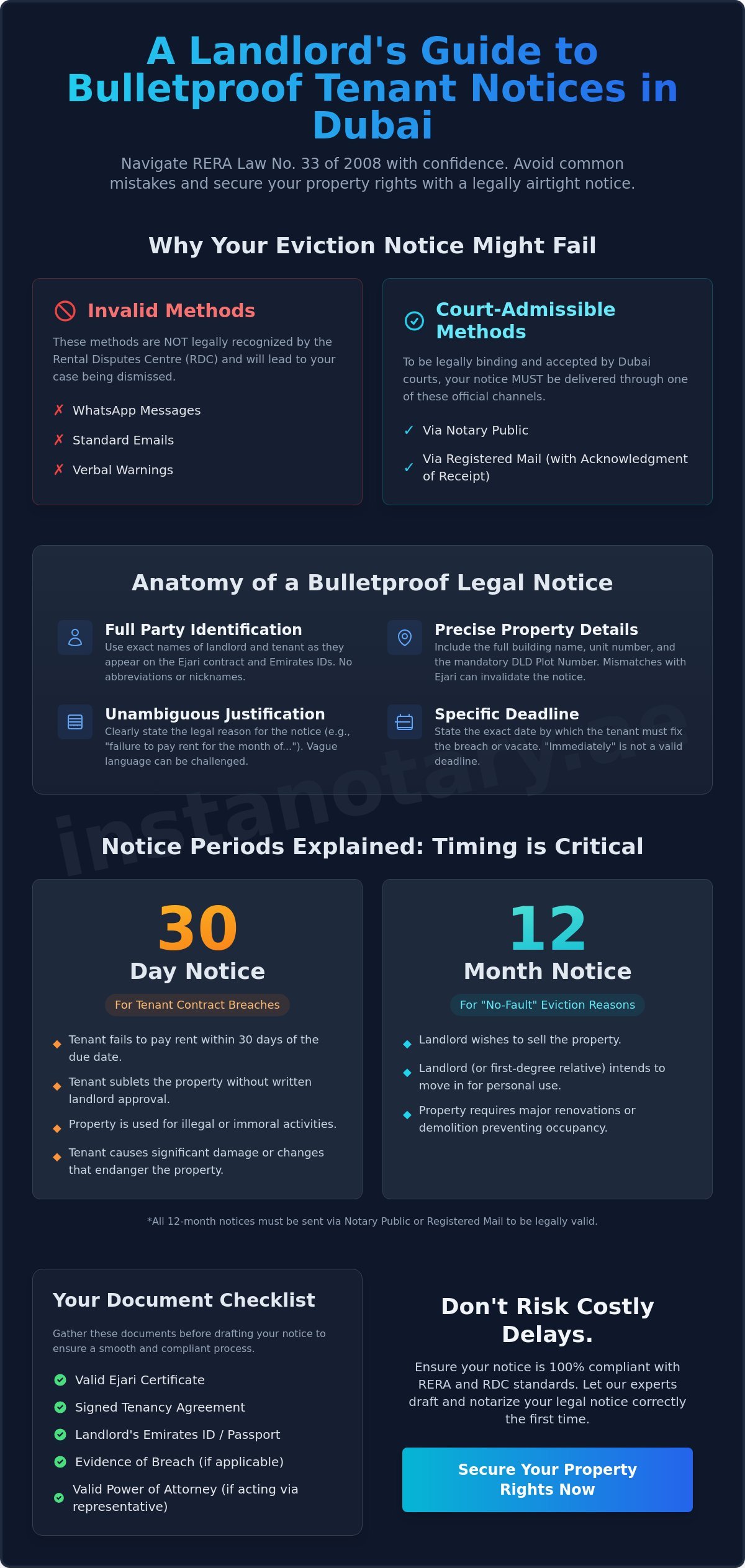
- Non-payment of rent: You can serve notice if the tenant fails to pay within 30 days of the due date, unless otherwise agreed.
- Subletting: If a tenant sublets the property without your express written approval, they’ve breached the contract.
- Illegal activities: Using the property for immoral or illegal purposes is grounds for immediate legal action.
- Personal use or sale: You must provide a full 12 months’ notice via Notary Public if you intend to sell the property or move in yourself.
Are you unsure if your specific situation qualifies for a legal eviction? It’s better to verify your grounds now than to face a rejected filing at the RDC later. Our team can help you prepare the right documents right from your office.
Essential Elements of a Valid Draft Legal Notice
Don’t let a minor clerical error invalidate your entire case at the Rental Disputes Center. A professional draft of legal notice to tenant requires absolute precision to hold up under Dubai’s strict regulatory framework. You’ve got to ensure every detail aligns perfectly with your Ejari records. If the names or property details differ even slightly from the official registration, you risk the court dismissing your notice entirely.
Your notice must include these core components to be legally binding:
- Party Identification: Use the exact names of the landlord and tenant as they appear on the Ejari contract and Emirates IDs.
- Property Specifics: Include the full building name, unit number, and the specific plot number. The Dubai Land Department uses these identifiers to track all rental property actions.
- Clear Justification: State the specific reason for the notice. Whether it’s non-payment of rent, property damage, or intent to sell, the language must be unambiguous.
- Defined Deadline: Specify the exact date by which the tenant must rectify the breach or vacate the premises.
If you aren’t sure about the current legal status of your tenancy, it’s wise to explore our drafting services to ensure your document meets all 2026 compliance standards.
Notice Periods: 30 Days vs. 12 Months
Timing is everything in Dubai real estate law. You’ll typically use a 30-day notice when a tenant breaches the contract. This applies to cases like unpaid rent or illegal subletting. However, if you intend to sell the property, carry out major renovations, or use the unit for personal occupancy, Law No. 33 of 2008 requires a 12-month notice. This long-term notice must be sent via Notary Public or registered mail to be enforceable.
Required Documents for Drafting Your Notice
Preparation prevents delays. You’ll need a copy of the current Ejari certificate and the original signed Tenancy Agreement. Keep your Emirates ID or Passport copy ready for verification. If a representative is signing on your behalf, they must provide a valid Power of Attorney UAE. Always attach evidence of the breach, such as bank statements showing missed payments or high-resolution photos of property damage, to strengthen your draft of legal notice to tenant.
The Notarization Process: Making Your Notice Legally Binding
You’ve spent hours researching laws only to find your tenant simply ignores your emails. It’s a common headache for landlords in Dubai. Without the official seal of the Dubai Courts, your communication lacks the weight needed for legal enforcement. To turn a simple letter into a powerful legal tool, you must follow a specific notarization path.
A professional draft of legal notice to tenant must be bilingual. While you might communicate with your tenant in English, the Dubai Courts and the Rental Dispute Centre (RDC) require an Arabic version. This isn’t just a courtesy; it’s a mandatory legal requirement. You’ll need a certified legal translator to ensure the Arabic text mirrors your English intentions perfectly.
Once your document is ready, you must submit it to a Notary Public Dubai for official stamping. This step verifies the document’s authenticity and ensures it complies with Law No. (33) of 2008. You’ll be required to pay government fees and service charges in UAE Dirhams (AED). These costs vary depending on the complexity of the notice and the number of parties involved.
Service is the final hurdle. You can’t just drop the notice in a mailbox. For the notice to be valid in court, it must be served via a court bailiff or registered mail through Emirates Post or Aramex. This provides you with a verified tracking number and proof of delivery. This evidence is your primary shield if the case eventually reaches the RDC.
Why Landlords Choose InstaNotary for Legal Drafting
We handle the heavy lifting of services so you don’t have to navigate complex government portals alone. Traditional notarization often involves physical queues and manual paperwork that eats into your day. We prioritize digital speed and precision. This is particularly vital for landlords managing essential legal documents for expats who may be residing outside the UAE. You get expert drafting and coordination from your home or office. It’s legal validity paired with modern convenience. Are you ready to secure your property rights without the stress of government bureaucracy?
Protect Your Investment with Professional Documentation
Protecting your property shouldn’t be stressful. You now understand that a valid draft of legal notice to tenant must strictly adhere to Law No. 33 of 2008. It also requires formal notarization to be legally binding in the UAE. A single error in phrasing or delivery can lead to months of delays at the Rental Dispute Center. Our specialists ensure your documents are 100% RERA compliant and professionally drafted in both English and Arabic. We remove the guesswork from the process.
If you’re an overseas landlord, you can even complete the entire notarization remotely through our secure digital platform. This saves you the time and expense of traveling to Dubai for a simple signature. We prioritize your schedule while maintaining the highest legal standards. You’ve worked hard for your investment, so don’t let a paperwork technicality put it at risk. Take the professional path to property management today.
Draft and Notarize Your Tenant Notice Instantly
Frequently Asked Questions
Can I send a legal notice to my tenant via WhatsApp in Dubai?
You can legally send a notice via WhatsApp, but it’s often risky for formal eviction or rent increase proceedings. While UAE Decree Law No. 46 of 2021 recognizes electronic signatures and communications, the Rental Dispute Centre (RDC) usually requires definitive proof that the tenant received and read the message. To avoid technical hurdles, most landlords choose a notarized notice delivered via registered mail or courier. This provides a clear paper trail that stands up in court without the ambiguity of “blue ticks” or blocked numbers.
How much does it cost to notarize a legal notice in Dubai?
Notarizing a legal notice through a private notary in Dubai typically costs between AED 300 and AED 600 per document. This price varies based on the number of pages and the specific nature of the notice. You’ll also need to factor in courier fees, which usually range from AED 100 to AED 200 for secure delivery within the UAE. Using a private notary service is a fast way to get your documents stamped without waiting for an appointment at a traditional government office.
What happens if a tenant refuses to receive the legal notice?
The legal process continues even if your tenant refuses to sign for the delivery or ignores the courier. If the notice is sent to the address listed in the Ejari contract and the courier provides a “refusal to accept” report, the RDC generally considers the service valid. When you prepare a professional draft of legal notice to tenant, ensure you keep the official delivery receipt and the courier’s tracking log. These documents serve as your primary evidence if the tenant later claims they weren’t informed of the eviction or lease changes.
Can I draft my own legal notice, or do I need a lawyer?
You aren’t legally required to hire a lawyer, but your draft of legal notice to tenant must strictly follow Law No. 33 of 2008. Any small error in the notice period or the stated reason for eviction can cause the RDC to dismiss your case entirely. Many landlords prefer using a facilitator like InstaNotary to ensure the document is legally sound and properly notarized. This approach gives you the legal validity you need with the digital convenience of a modern service, saving you from the high costs of a traditional law firm.
Disclaimer
This article is for general informational purposes only and does not constitute legal or professional advice. Procedures, requirements, and fees may vary depending on the relevant authority and the specific case. Please contact us directly for guidance based on your situation.