
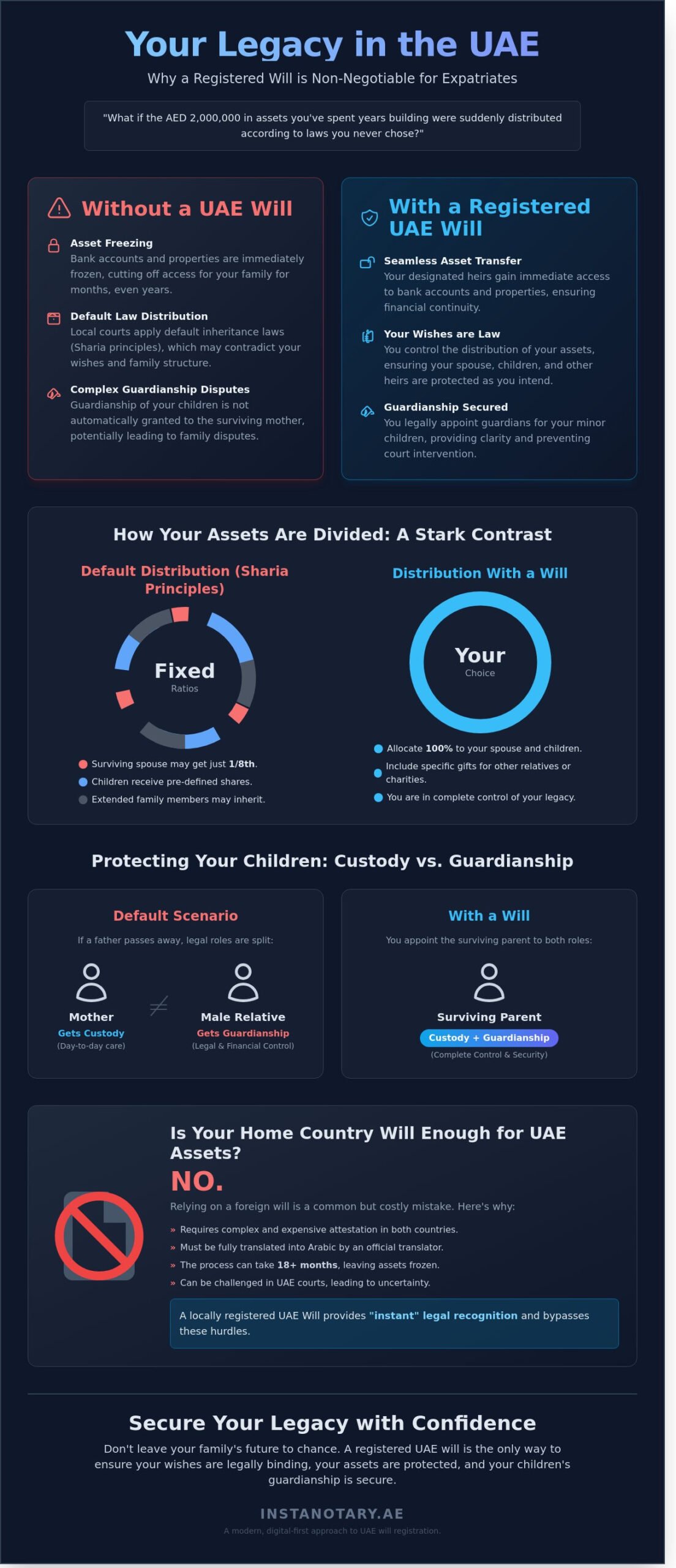
What if the AED 2,000,000 in assets you’ve spent years building in Dubai were suddenly distributed according to laws you never chose? It’s a sobering thought, yet many residents still wonder why expats need a will in uae when they already have one in their home country. You likely believe that your hard-earned property and bank accounts should automatically pass to your spouse or children. In reality, without a UAE-registered document, local authorities may apply default inheritance laws that lead to frozen accounts and complex guardianship disputes.
We understand the anxiety that comes with navigating the intersection of Sharia and the latest Personal Status Law. This 2026 guide will show you exactly how to protect your family and ensure your wishes are legally binding. You’ll discover the critical risks of asset freezing, the steps to secure child guardianship, and how to facilitate a seamless registration process. By the end of this article, you’ll have a clear, step-by-step path to legal certainty, allowing you to secure your legacy from the comfort of your home or office.
Key Takeaways
- Understand how the UAE Civil Code and Sharia principles apply to your estate and why relying on default inheritance laws puts your local assets at risk.
- Secure your children’s future by learning the vital legal distinction between “custody” and “guardianship” under current Dubai regulations.
- Prevent the immediate freezing of bank accounts and ensure a seamless transfer of real estate titles to your rightful heirs.
- Evaluate the benefits of DIFC versus Abu Dhabi Civil Wills to determine the best legal framework for why expats need a will in uae to protect their legacy.
- Discover how to facilitate a legally binding registration through a modern, digital-first approach that ensures absolute compliance with UAE regulations.
Understanding UAE Inheritance Laws for Expats in 2026
Living in the UAE offers unparalleled lifestyle benefits, but managing your legacy requires a clear understanding of the local legal framework. Many residents mistakenly assume their assets are protected by the laws of their home nation. In reality, the UAE’s dual legal system dictates how your property, bank accounts, and even guardianship of your children are handled after you pass away. If you don’t have a registered document in place, the courts default to Sharia principles or specific local statutes that might contradict your personal wishes. This is exactly why expats need a will in uae to ensure their hard-earned assets go to the right people without unnecessary government intervention.
The legal landscape shifted significantly with Federal Decree-Law No. 41 of 2022, which became the standard for non-Muslim inheritance in 2023. By 2026, these regulations have matured, yet many expats still rely on “default” distributions. These defaults rarely align with modern family structures, especially for those with assets spread across Dubai, Abu Dhabi, or the Northern Emirates. Without a locally registered will, the process of distributing an estate worth 1,000,000 AED or more can become a multi-year legal battle that drains the estate’s value through court fees and translation costs.
The Myth of Automatic Protection for Non-Muslims
A frequent misconception among the expat community is that the “law of the home country” applies automatically to their UAE assets. While the 2023 Civil Personal Status Law allows for this in theory, the practical application is complex. In the absence of a UAE-registered will, the local courts require heirs to provide legalized, translated copies of foreign laws and proof of their validity. This process often leads to years of legal delays and high administrative costs. Relying on a home-country will is risky because it might not meet the specific attestation requirements of the UAE Ministry of Justice. Understanding why expats need a will in uae starts with recognizing that a locally recognized document provides the only “instant” path to asset release. For instance, a registered will ensures that a 500,000 AED savings account isn’t frozen for 18 months while the court verifies foreign probate documents.
Sharia Law vs. Personal Status Law: Key Differences
The difference between Sharia-based distribution and the Civil Personal Status Law is stark, particularly regarding surviving spouses and female heirs. Under Sharia, assets are often distributed among a wider circle of relatives, which can leave a widow with as little as one-eighth of the estate if there are children. This can create immediate housing and financial instability if the family home was only in the deceased’s name. The Personal Status Law for non-Muslims serves as the primary legal alternative to Sharia, granting more flexibility and protection for the nuclear family. For a comprehensive understanding of how these recent legal reforms specifically protect your assets and family interests, our detailed guide on UAE inheritance law for non-Muslims provides essential insights into the current legal framework.
- Asset Splits: Sharia uses fixed ratios that often favor male heirs; the Personal Status Law allows for 50/50 splits between spouses unless otherwise specified.
- Guardianship: Without a will, guardianship of minor children isn’t guaranteed to the surviving mother and may involve extended male relatives.
- Digital Assets: Modern wills in 2026 now specifically cover cryptocurrency and digital portfolios, which are often overlooked in default Sharia distributions.
By choosing to draft and register a will, you move from a position of legal uncertainty to one of absolute clarity. It’s the most effective way to protect your family’s future from the comfort of your home or office, ensuring that your intentions are legally binding and respected by UAE authorities.
Protecting Your Children: Guardianship Risks Without a Will
For parents living in Dubai or Abu Dhabi, the safety of their children is the highest priority. However, many families overlook the critical legal distinction between “custody” and “guardianship” under UAE law. Custody, or Hadhana, refers to the physical day-to-day care and nurturing of the child. Guardianship, or Wilaya, involves the legal right to manage the child’s financial affairs, education, and travel. Traditionally, these roles are separate. If a father passes away, guardianship does not automatically transfer to the mother in the same way it might in Western jurisdictions. Instead, it may default to the closest male relative on the father’s side.
This legal framework creates significant uncertainty for families who haven’t documented their wishes. If both parents pass away without a registered will, the UAE courts must intervene to protect the minors. This intervention is not meant to be intrusive, but rather to ensure the child’s safety under the law. Without a clear directive, the Public Prosecution may take temporary custody of the children while the court searches for suitable relatives. This process can take weeks or even months, during which the children might be placed in state-supervised care. Understanding these implications of recent legal changes is vital for anyone raising a family in the region.
This uncertainty is a primary reason why expats need a will in uae. A registered will acts as a formal instruction to the UAE Ministry of Justice and the local courts. It allows you to bypass default legal distributions and nominate the exact individuals you trust to raise your children. By proactively drafting these documents, you ensure that your children remain with people you have chosen, rather than individuals appointed by a judge who doesn’t know your family dynamics.
Temporary vs. Permanent Guardianship
A comprehensive will must address two distinct scenarios. First, you need to name local temporary guardians. These are trusted friends or residents within the UAE who can take immediate physical custody of your children for the first 48 to 72 hours. This prevents the children from entering the foster system while your permanent guardians travel to the UAE. Second, you must name permanent guardians, usually family members abroad. Ensuring your permanent guardians are recognized by the Dubai courts requires specific attestation of their documents. As we look toward stricter legal requirements for guardian nominations in 2026, keeping your will updated with current passport copies and contact details for all nominees is essential for seamless execution.
Avoiding Court-Appointed Guardians
The emotional and logistical toll of a court-led guardianship decision can be devastating for a grieving family. When the court is forced to appoint a guardian, it must follow a rigid hierarchy that may not reflect your personal values or your child’s best interests. A clear, registered directive prevents messy family disputes across borders, as the court will honor the choice stated in your notarized will. To solidify your choice, you’ll need to provide the full names, addresses, and passport numbers of your chosen guardians. You can prepare your guardianship declarations online to ensure your family’s future is secure and legally protected from day one.
Federal Decree Law No. 41 of 2022 has made it easier for non-Muslim expats to apply the laws of their home country to their personal affairs. However, this right is only guaranteed if you have a registered will in place. Without it, you leave your children’s future to the discretion of a legal system that, while fair, operates on default rules that may not suit your specific needs. Taking 30 minutes to formalize your guardianship wishes today can prevent years of legal complications for your loved ones later.
Asset Freezing and Distribution: Securing Your Dubai Investments
When a resident passes away in the Emirates, the legal system moves quickly to protect the deceased’s estate. This process starts with the immediate freezing of all UAE-based bank accounts. Local banks typically receive notification from the authorities within 24 to 48 hours of a death certificate being issued. Once this happens, access to funds is restricted until the local courts issue a Grant of Probate or a succession certificate. This sudden lack of liquidity can leave families unable to pay for daily expenses, school fees, or even funeral costs.
Understanding the severity of this freeze explains why expats need a will in uae to protect their hard-earned wealth. Without a registered will, the unfreezing process relies on the UAE Personal Status Law. This often involves a lengthy court procedure that can last six months to a year. During this time, your family might be forced to rely on external financial support while your assets remain locked in the banking system. A registered will provides the legal roadmap the courts need to fast-track the release of these funds to your chosen beneficiaries.
Bank Accounts and Financial Liquidity
Many expats believe that holding a joint bank account provides a safety net for their spouse. In the UAE, this isn’t the case. Unlike many Western jurisdictions that follow the “right of survivorship,” UAE banks often freeze joint accounts entirely upon the death of one holder. This is done to ensure that all potential heirs, as defined by law, receive their legal share. Having a registered will is the most effective way to ensure your spouse retains access to the capital required to maintain their lifestyle. It acts as a clear directive to the UAE courts, allowing for a seamless transition of liquid assets without the typical 12-month waiting period associated with intestate estates.
Real Estate and Business Shares
Real estate ownership in Dubai or Abu Dhabi represents a significant investment that requires specific protection. Under UAE law, “in-kind” assets like villas or apartments are subject to Sharia-based distribution if no valid will is in place. This can lead to fractional ownership. For instance, a surviving wife with children may only be entitled to 12.5% of the family home, while the remainder is split among children and potentially other distant relatives. A registered will allows you to opt-out of these default distributions, ensuring your property passes directly to your intended heirs.
Business continuity is another critical concern for entrepreneurs. If you own shares in an LLC or a Free Zone company, your death could lead to a suspension of the company’s trade license or the freezing of corporate bank accounts. This prevents the business from paying salaries or fulfilling contracts. You can mitigate these risks by notarizing corporate documents and share transfer agreements that align with your succession plan. This ensures your business remains operational and your partners aren’t left in a legal vacuum.
Securing your assets doesn’t have to be a complex or intimidating process. By taking proactive steps now, you can ensure your family’s financial future is never left to chance. If you’re ready to protect your Dubai investments, you should start the process today. Reach out to our team via WhatsApp or call us directly to facilitate the preparation of your legal documents.
The core reason why expats need a will in uae is to maintain control over assets that would otherwise be distributed by local courts. Whether it’s a luxury apartment in Dubai Marina or a growing tech startup in a Free Zone, your assets deserve a clear succession path. A registered will, supported by correctly notarized documentation, provides the absolute certainty that your legacy remains exactly as you intended.
Choosing the Right Registry: DIFC vs. Abu Dhabi Wills
Selecting the correct registry is the most critical decision you’ll make during the estate planning process. In the UAE, non-Muslims have two primary legal pathways to secure their assets: the Dubai International Financial Centre (DIFC) and the Abu Dhabi Judicial Department (ADJD). Each registry offers unique benefits tailored to different asset portfolios and budgets. Understanding these distinctions is a key reason why expats need a will in uae, as the wrong choice could lead to jurisdictional delays during probate.
DIFC Wills: The Common Law Advantage
The DIFC Wills Service Centre operates under English-language Common Law principles. This makes it the preferred choice for expats from the UK, Australia, or Canada who want a legal framework similar to their home countries. You can opt for a “Full Will” covering all UAE assets, or specific “Property Wills” and “Financial Assets Wills” for targeted protection. Registration for a single “Full Will” costs approximately AED 10,000 plus VAT. It’s a premium, digital-first service that allows for remote witnessing via video link, ensuring your documents are legally binding without requiring a physical visit to the centre.
Abu Dhabi Civil Wills: A Nationwide Solution
The ADJD civil will is a robust, cost-effective option governed by Law No. 14 of 2021. Unlike some regional options, an ADJD will provides comprehensive coverage across all seven emirates. The application process is streamlined for non-Muslim residents and carries a registration fee of approximately AED 950. While the cost is lower, the legal weight is substantial; Dubai courts frequently recognize and execute ADJD wills through established judicial cooperation. It’s an ideal choice for those seeking a “one-stop solution” for a diverse asset portfolio spread across the country.
The UAE is rapidly moving toward a 100% digital judiciary by 2026. This transformation means that remote registration and electronic storage are now the standard, not the exception. Both the DIFC and ADJD registries have already adopted sophisticated digital portals to facilitate your application. You can now manage your entire estate planning journey from the comfort of your home or office, combining legal validity with modern digital convenience.
Cost comparisons reveal a significant gap between the two registries. A DIFC “Full Will” for a couple can exceed AED 15,000 in registration fees alone, whereas the ADJD route remains under AED 2,000 for similar coverage. However, the DIFC offers more flexibility for complex international trust structures. Your choice should depend on where your assets are located and the complexity of your family’s needs. Regardless of the registry you choose, having a registered document is the only way to bypass the default distribution rules of the local courts. This clarity is exactly why expats need a will in uae to protect their families from long legal battles.
Don’t leave your family’s future to chance. Start your application now to ensure your assets are protected by the right registry.
The shift toward digital registration has also introduced remote witnessing protocols. By 2026, the government aims to have all notary and registration services fully automated. This means your will is stored in a secure, encrypted database that is instantly accessible by the courts when needed. This technological edge reduces the risk of lost documents and ensures that your final wishes are executed with speed and precision. It’s a seamless, hassle-free way to achieve peace of mind in a fast-paced environment.
How InstaNotary Facilitates Your Will Registration in Dubai
Securing your legacy in a foreign country involves more than just listing your wishes on paper. It requires a precise understanding of the UAE Civil Transactions Law and the specific requirements of registries like the DIFC Wills Service Centre or the Abu Dhabi Judicial Department (ADJD). Insta Notary Services acts as your dedicated facilitator, removing the friction from what is often a complex administrative journey. We don’t just provide templates; we offer a comprehensive support system designed to ensure your documents meet every legal benchmark.
Understanding why expats need a will in uae is the first step, but executing one correctly is what truly protects your family. Our team assists in the meticulous preparation of all supporting documentation, from title deeds for Dubai properties to corporate papers for Free Zone companies. We streamline the attestation process, ensuring that every signature and stamp aligns with the Ministry of Justice standards. This proactive approach reduces the administrative burden on your family, preventing the stress of frozen bank accounts or legal disputes during an already difficult time.
Our Professional Facilitation Process
We’ve refined our process to be as efficient as possible, allowing you to complete your requirements from the comfort of your home or office. Our “Efficient Expert” approach follows three logical steps:
- Step 1: Asset and Guardianship Consultation. We begin with a detailed consultation to audit your UAE-based assets. Whether you hold a 5 million AED villa in Palm Jumeirah or a simple savings account, we identify exactly what needs protection. This stage also focuses on guardianship, ensuring your children’s future is secure according to your specific wishes.
- Step 2: Expert Drafting. Our team drafts your will to meet stringent UAE legal standards. We avoid the vague language that often leads to probate delays. Every clause is reviewed to ensure it’s legally binding and compliant with the 2020 legal reforms regarding non-Muslim inheritance.
- Step 3: Registration Guidance. We navigate the registration process at the DIFC or ADJD on your behalf. This includes handling the digital uploads, scheduling the necessary appointments, and ensuring all supporting documents are notarized and ready for official approval.
Why Peace of Mind Starts with Professional Support
Drafting errors are the primary reason for will rejection at the probate stage. A single ambiguous phrase regarding asset distribution can lead to months of court delays and thousands of dirhams in legal fees. By choosing a local partner like Insta Notary Services, you gain access to real-time knowledge of Dubai’s evolving legal system. We act as your one-stop solution, bridging the gap between your personal intentions and the region’s formal legal requirements.
The value of having a local facilitator cannot be overstated. We understand the nuances of the UAE Ministry of Justice and the specific formatting required by local courts. This expertise ensures that your will isn’t just a document, but a legally valid shield for your assets. We prioritize your time and legal integrity, replacing the image of a slow, paper-heavy process with a fast-paced, digital-first identity. This balance of legal gravity and modern convenience is why expats trust us to handle their most sensitive documentation. For those seeking comprehensive guidance on the entire process, our detailed resource on writing a will in Dubai provides step-by-step instructions for every aspect of estate planning in the Emirates.
Don’t leave your family’s future to chance or outdated regulations. Contact Insta Notary Services today to secure your family’s future with a professionally facilitated will that stands up to legal scrutiny. Our team is ready to provide the clarity and security you need to thrive in the UAE.
Protect Your Dubai Legacy and Family Future
Living in the Emirates offers incredible opportunities, but it requires proactive legal planning to protect your interests. Without a registered will, local courts apply default distribution laws that often lead to immediate asset freezing and complex guardianship hurdles. You don’t want your family’s future left to chance or caught in lengthy administrative delays. By selecting the right registry, such as the DIFC or ADJD, you maintain full control over your estate and ensure your children remain with your chosen guardians. It’s the most responsible step a Dubai resident can take in 2026.
Understanding why expats need a will in uae is the foundation of a secure life in the region. InstaNotary provides expert facilitation that aligns with UAE Ministry of Justice standards, offering fast-track support for all expat legal documentation. We handle the technical registration process from the comfort of your home or office. Our team simplifies the complexities of inheritance laws so you can enjoy your life in Dubai with absolute confidence. Our digital-first approach ensures your documents are handled with precision and speed.
Secure Your Assets and Family-Start Your Will Facilitation Today
Taking this small step today provides your loved ones with lasting certainty for years to come.
Frequently Asked Questions
Is a will from my home country valid in the UAE?
A will from your home country isn’t automatically recognized and often requires a complex legalization process. You must have the document translated into Arabic, attested by the Ministry of Foreign Affairs, and verified by local courts. This process is often slow and expensive. Most legal experts recommend a UAE-specific will to ensure your assets are distributed exactly as you intend without local judicial delays.
What happens if an expat dies in Dubai without a will?
If you die intestate, the UAE courts may apply Sharia-derived principles to distribute your local assets. This often results in fixed shares for specific family members that might not align with your personal wishes. Your bank accounts, including joint ones, are typically frozen immediately until probate is settled. This is exactly why expats need a will in uae to protect their families from financial hardship and legal uncertainty.
Can I register a will online in the UAE in 2026?
Yes, you can register your will through fully digital platforms provided by the DIFC Wills Service Centre or the Abu Dhabi Judicial Department. By 2026, these systems have become the standard for registration, offering virtual witness sessions via secure video calls. This digital convenience allows you to secure your legacy from the comfort of your home or office while maintaining full legal validity under UAE law.
Does the new UAE Personal Status Law apply to all expats?
Federal Decree-Law No. 41 of 2022 applies to non-Muslim expats and allows the law of their home country to govern their inheritance. However, if you haven’t registered a formal document, local regulations still create significant administrative hurdles for your heirs. Relying on the law without a written will leads to lengthy delays. We facilitate the drafting process to ensure your estate is handled according to your specific instructions.
How much does it cost to register a will in Dubai?
Registration fees for a single will at the DIFC Wills Service Centre are approximately AED 10,000 plus VAT. If you choose the Dubai Courts, the registration fee is roughly AED 2,165 per person. These figures don’t include professional fees for drafting and facilitation services. Our team provides a one-stop solution to help you navigate these costs while ensuring your documents meet all legal requirements.
Can I include my Dubai property in a DIFC will?
You can absolutely include any real estate located in Dubai or Ras Al Khaimah within a DIFC will. The DIFC Wills Service Centre maintains a specific agreement with the Dubai Land Department to ensure the seamless transfer of property titles to your beneficiaries. This makes it a robust option for investors who want to protect their high-value real estate assets through a familiar common-law framework.
Do I need a lawyer to write a will in the UAE?
While it’s not a strict legal requirement to hire a lawyer, it’s highly recommended to use a professional facilitator to avoid technical errors. A poorly drafted document can be challenged in court or rejected during the registration process. We assist by preparing and drafting documents that meet all current UAE Ministry of Justice standards, ensuring your will is legally binding and easy to execute.
What is the difference between an interim and permanent guardian?
An interim guardian is a temporary appointee who takes immediate care of your children if both parents pass away, usually for a short window of 48 hours. A permanent guardian is the individual who will raise your children until they reach the age of 21. Specifying both in your will prevents local authorities from placing your children into state care while family members travel to the UAE from abroad.
Disclaimer
This article is for general informational purposes only and does not constitute legal or professional advice. Procedures, requirements, and fees may vary depending on the relevant authority and the specific case. Please contact us directly for guidance based on your situation.