
What if your UAE bank accounts were frozen within 24 hours of your passing, leaving your family without immediate access to essential funds? For many of the 9 million expats living in the Emirates, the assumption that home-country inheritance laws automatically apply is a risky oversight. You’ve worked hard to build a life here, yet without a legally registered document, your property and savings could face default distribution under local regulations. We agree that writing a will in dubai often feels like an intimidating hurdle, especially when you’re trying to balance complex legal requirements with a fast-paced lifestyle.
You deserve the absolute certainty that your assets and your children’s guardianship are fully protected. This complete 2026 guide provides the clarity you need to bypass legal delays and secure your family’s future. We’ll preview the critical differences between DIFC and ADJD jurisdictions, list every required document, and explain how to facilitate a seamless registration process. From understanding costs in AED to final attestation, you’re about to gain a clear, professional roadmap to total peace of mind.
Key Takeaways
- Protect your family’s future by understanding how a registered will prevents automatic asset freezes and ensures Sharia default principles do not apply to your estate.
- Compare the distinct benefits of DIFC and ADJD jurisdictions to determine which legal framework provides the most robust protection for your specific asset portfolio.
- Navigate the essential legal requirements for writing a will in dubai, including the strategic appointment of executors and guardians capable of managing UAE-based affairs.
- Debunk common myths regarding foreign wills and learn why local registration is the only guaranteed way to secure your property, shares, and bank accounts.
- Streamline the drafting and registration process with professional facilitation that ensures your documents comply with the latest 2026 UAE inheritance regulations.
Why Writing a Will in Dubai is Essential for Expats in 2026
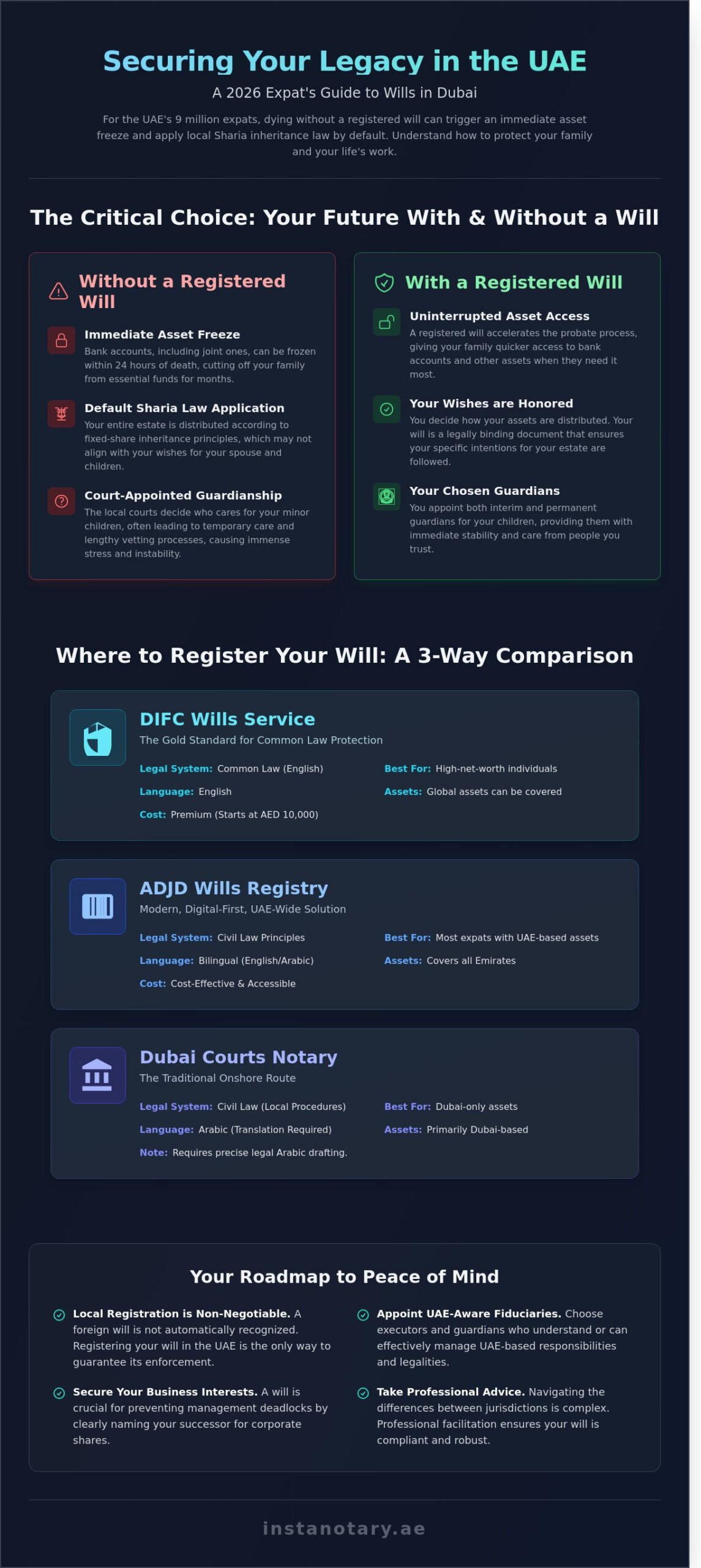
Living in the UAE offers an incredible lifestyle, but it comes with specific legal responsibilities that differ significantly from your home country. If you pass away without a registered document, the UAE Legal System typically applies Sharia principles to your estate by default. While these laws are well-defined, they often distribute assets in fixed shares that might not align with your personal wishes for your spouse or children. Writing a will in dubai ensures your specific intentions take precedence over these default local regulations.
The “Asset Freeze” is a sudden reality many families face. Once a death is officially reported, UAE authorities often freeze both sole and joint bank accounts to protect the rights of potential heirs and creditors. This can lock your dependents out of essential liquidity for months. Similarly, property titles are restricted until a court order clears the transfer. By 2026, the application of the 2023 Federal Decree-Law on Personal Status for non-Muslims has matured, allowing expats to opt for civil law. However, you can only access these protections if you have a valid, registered will in place.
Asset Protection and Probate Avoidance
A registered will acts as a clear roadmap for Dubai courts, which helps accelerate the probate process. Without this document, transferring real estate assets valued at 2,000,000 AED or more can become a complex, years-long legal hurdle. It’s equally vital for business owners. If you hold corporate shares in a local LLC, a will prevents management deadlocks by naming your successor. You shouldn’t rely on a “Right of Survivorship” here; assets don’t always pass automatically to a surviving spouse in the UAE without specific legal drafting and registration.
Securing Your Family Future
Guardianship is the most critical factor for expat parents. If both parents pass away without a legally recognized will, the local courts possess the authority to determine who cares for your children. This often leads to minors being placed in temporary care while the court vets a permanent guardian. Your will allows you to name interim guardians who can step in immediately, alongside permanent guardians who may live abroad. This provides your children with immediate stability and prevents the court from making these deeply personal decisions. For more details on these protections, read our guide on Why Expats Need a Will in the UAE.
Choosing the Right Jurisdiction: DIFC vs. ADJD vs. Dubai Courts
Deciding where to register your legal documents is the most critical step when writing a will in dubai. The UAE offers three distinct legal pathways for expats, each with its own set of rules, costs, and procedural requirements. Your choice depends on where your assets are located, your budget, and whether you prefer a system based on civil law or common law.
- DIFC Wills: These follow common-law principles, offering high levels of testamentary freedom for non-Muslims.
- ADJD Wills: A cost-effective, digital-first option that provides UAE-wide coverage.
- Dubai Courts: The traditional route which requires documents to be in Arabic and follows local civil law procedures.
The DIFC Wills Service
The DIFC Courts Wills Service is specifically designed for non-Muslims who want their estate handled under English-language, common-law standards. This jurisdiction is the gold standard for high-net-worth individuals and those with complex global assets. It allows you to opt out of Sharia-compliant inheritance distribution entirely. While registration fees are higher, often starting at AED 10,000 for a single will, the legal certainty it provides is a major benefit. You can find more details on how this compares to other options in our guide on DIFC Wills vs AD Wills.
The ADJD Non-Muslim Wills Registry
The Abu Dhabi Judicial Department (ADJD) has revolutionized the process for Dubai residents. It’s an incredibly popular choice because it’s both affordable and efficient. In 2026, the registry offers a simplified digital registration process that you can complete from the comfort of your home or office. Government registration fees are significantly lower than the DIFC, typically around AED 950. This registry is an excellent “one-stop solution” for families whose primary assets are located within the UAE. It provides a seamless blend of legal validity and digital convenience.
When writing a will in dubai, you must also consider language requirements. Dubai Courts require all documents to be translated into Arabic by a certified legal translator, which can add to the processing time. In contrast, both the DIFC and ADJD allow for English-language documentation, making the process much more accessible for the expat community. If you’re feeling overwhelmed by these choices, you can contact our team to help facilitate the drafting of your documents for the correct jurisdiction.
UAE Inheritance Laws: Common Misconceptions and Risks
Many expats mistakenly believe that a will drafted in their home country automatically protects their assets in the UAE. It doesn’t. Relying on a foreign document without local registration creates a legal vacuum known as “Renvoi.” This happens when UAE courts refer to your home country’s laws, but those laws refer back to the location of the assets. This loop often leads to assets being distributed according to local default regulations rather than your personal wishes. Writing a will in dubai is the only proactive way to break this cycle and ensure your legacy is handled according to your specific instructions.
The Problem with Foreign Wills
Using a foreign will in the UAE is a slow and expensive process. Your executors will face significant administrative hurdles that can delay the distribution of assets for months. Foreign wills must be translated into Arabic by a licensed legal translator, attested by the Ministry of Foreign Affairs, and notarized to even be considered by local courts. Even after these steps, a UAE judge may find clauses that conflict with local public policy, potentially rendering parts of your will unenforceable. These complications often result in legal fees exceeding AED 15,000, a cost that your grieving family will have to bear upfront.
Recent Legal Reforms for Non-Muslims
The legal landscape changed significantly on February 1, 2023, with the implementation of Federal Decree-Law No. 41 of 2022. This law provides a civil framework for non-Muslim inheritance, moving away from Sharia defaults for expats. While this is a positive step, relying on “default law” remains a high-risk strategy. Default laws are generic and don’t account for specific family dynamics, business ownership, or unique asset portfolios. For a comprehensive understanding of how these reforms impact your estate planning, refer to our detailed guide on UAE inheritance law for non-Muslims.
By opting out of Sharia inheritance law through a formally registered document, you secure legal certainty. You can view our full range of assistance for essential legal documents to understand how to protect your interests. Writing a will in dubai provides the digital convenience and legal validity required to bypass generic default rulings.
It’s also a common myth that holding a Golden Visa or permanent residency provides an exemption from these rules. Your residency status is a migration benefit, not a legal shield against local probate procedures. Regardless of how long you’ve lived in the UAE, your bank accounts and local assets will be frozen immediately upon notification of death. A registered will is the primary tool used to release these freezes and protect your family’s immediate financial security.
The Step-by-Step Process of Drafting and Registering Your Will
Securing your legacy through writing a will in dubai requires a methodical approach to ensure every asset is protected under local laws. You’ll start by creating a comprehensive inventory of your UAE-based holdings. This list should include property title deeds, bank accounts, investment portfolios, and any corporate shares held in free zone or mainland companies. Accuracy at this stage is vital. It prevents legal hurdles during the probate process and ensures your beneficiaries face no delays.
Next, you must appoint executors and guardians. These individuals should be capable of managing UAE-based affairs and navigating local administrative requirements. It’s often practical to choose someone who understands the region’s specific regulatory environment. By 2026, the registration process has become almost entirely digital. You can expect a streamlined video conferencing appointment for final verification. This modern approach replaces the need for multiple physical visits to government offices, making the process faster than ever before.
Required Documentation for a Dubai Will
To facilitate a smooth registration, you’ll need high-resolution copies of specific documents for the testator and all named parties. Ensure you have the following ready:
- Valid Emirates ID and Passport copies for the testator.
- Passport copies for all beneficiaries and executors.
- Property title deeds or Oqood certificates for real estate.
- Trade licenses and share certificates for business owners.
Before final submission, you’ll often need assistance with notarizing documents to verify their authenticity. This step ensures that your supporting paperwork meets the rigorous standards required by the DIFC or Dubai Courts. It’s a critical part of maintaining legal validity.
Attestation and Legal Translation
If you choose to register your will through the local Dubai Courts, a certified Arabic translation is mandatory. This translation must be performed by a legal translator licensed by the UAE Ministry of Justice. The attestation process confirms the document’s legal validity across all UAE authorities. Typically, the timeline from the initial draft to receiving your final registration certificate ranges from 3 to 7 business days. This depends on the complexity of your estate and the specific jurisdiction you select.
Protect your assets with confidence. Speak with our specialists today to facilitate your will registration process with speed and precision.
How Insta Notary Services Facilitates Your Will Registration in Dubai
Securing your legacy shouldn’t feel like an uphill battle against paperwork. At Insta Notary Services, we act as your premium facilitator to simplify the process of writing a will in dubai. We bridge the gap between complex legal requirements and your peace of mind. Our team ensures every document meets the strict standards set by the UAE Ministry of Justice and relevant registries. We don’t just provide templates; we provide a managed journey that transforms a daunting legal task into a streamlined, digital-first experience.
Our Facilitation Services
Choosing between the DIFC Wills Service Centre and the Abu Dhabi Judicial Department (ADJD) depends on your specific asset portfolio and residency status. We provide personalized consultations to identify the most cost-effective and legally sound path for your family. Our experts handle the end-to-end management of your file. This includes drafting the initial document to comply with the latest 2026 UAE regulations, which have introduced more flexible options for non-Muslim residents. We manage the professional legal translations into Arabic, coordinate the attestation and notarization steps, and handle all appointment scheduling. Contact Insta Notary Services for a consultation to see how we can assist you.
The Insta Notary Services Advantage
Traditional legal processes often involve long waiting times and confusing jargon. We replace that frustration with a service-oriented approach that prioritizes your time. Our “Efficient Expert” model ensures your sensitive family matters are handled with absolute security and precision. By using our facilitation services, you avoid the 15% to 20% delay rates often caused by minor clerical errors in self-filed applications. We provide a one-stop solution where legal validity meets digital convenience. It’s a premium concierge experience designed for the modern expat who values speed without compromising on legal integrity. Whether you have property in Dubai Marina or business interests in the free zones, we ensure your assets are protected under the correct legal framework from the comfort of your home or office. Start drafting your Dubai will today to protect your family’s future.
Protect Your UAE Assets and Legacy Today
Securing your legacy in the Emirates isn’t just about wealth; it’s about certainty. By 2026, the legal landscape for expats has become more streamlined, yet the risks of leaving your estate to default local regulations remain high. Choosing the right jurisdiction, whether it’s the DIFC Wills Service Centre or the ADJD, is the most critical decision you’ll make to protect your family’s future. Writing a will in dubai ensures that your property, bank accounts, and guardianship wishes are legally recognized and strictly followed by the authorities.
InstaNotary provides the expert facilitation you need to navigate these complexities from the comfort of your home or office. Our team specializes in Ministry of Justice compliant drafting assistance, ensuring every document meets the highest legal standards for validity. We offer bespoke services for both DIFC and ADJD registries, providing a seamless path for expats and investors to formalize their intentions. You don’t have to face the intimidation of legal paperwork alone when our efficient experts are ready to guide you through every step.
Secure Your Family’s Future: Facilitate Your Will Registration Today
Take control of your estate today and gain the peace of mind that comes with professional, legally binding protection for your loved ones.
Frequently Asked Questions
Can non-Muslims write a will in Dubai?
Yes, non-Muslims can legally register a will in Dubai to protect their assets and define guardianship for their children. Under UAE Decree Law No. 41 of 2022, expats have the right to choose a civil law framework or the laws of their home country for inheritance. This provides a clear, legally binding path that bypasses default Sharia distribution for non-Muslim residents.
Is a DIFC will valid for assets in other Emirates like Abu Dhabi?
A DIFC “Full Will” is valid for assets located throughout all seven Emirates, including Abu Dhabi and Sharjah. Since the 2017 regulatory updates, the DIFC Wills Service Centre has expanded its jurisdiction to cover assets across the entire UAE and even global holdings. It’s a comprehensive solution for expats who own property or businesses in multiple locations across the country.
How much does it cost to register a will in Dubai in 2026?
Registering a single will at the DIFC Wills Service Centre in 2026 costs approximately AED 10,000; meanwhile, a mirror will for couples is priced at AED 15,000. If you opt for the Dubai Courts civil will, the registration fee is roughly AED 2,165 per testator. These figures cover government registration fees, but you should also budget for professional drafting and facilitation services to ensure compliance.
Do I need to hire a lawyer to write a will in Dubai?
You aren’t legally required to hire a lawyer, but professional assistance is vital for ensuring your document meets strict UAE legal standards. Expert facilitators help you navigate the complexities of writing a will in dubai to prevent future probate delays or challenges. Most expats choose professional drafting to ensure their specific asset distribution is clear, enforceable, and tailored to their family’s needs.
What happens to my bank account if I die without a will in Dubai?
Your bank accounts, including joint accounts, are typically frozen immediately upon notification of death until the court issues an inheritance certificate. Without a registered will, the UAE courts apply default civil law or Sharia-compliant distribution rules under the 2022 Personal Status Law. This process often takes 6 to 12 months to resolve, which can leave your dependents without immediate access to essential funds.
Can I include my business shares in a Dubai will?
You can include shares in LLCs, free zone companies, or sole establishments in your Dubai will to ensure a smooth business succession. It’s essential to check your company’s Memorandum of Association first, as it must allow for the transfer of shares to heirs. We facilitate the review of these corporate documents to ensure your business interests are protected and legally transferable to your beneficiaries.
How long does the will registration process take?
The formal registration appointment usually takes between 45 and 60 minutes once your documents are drafted and reviewed. If you utilize a digital registration service, you can complete the entire process from the comfort of your home or office via a video call. The total turnaround time, including initial drafting and document verification, typically spans 5 to 10 working days for most clients.
Can I change or update my will after it is registered?
You can modify or revoke your will at any time as long as you have the mental capacity to make those decisions. Updating your wishes requires a formal “Codicil” or the registration of a new document that supersedes the previous one. Current registration fees for modifications at the DIFC stand at approximately AED 550 per update; this ensures your estate plan stays current with your life changes.